Why Internal Agents Must Be Rebuilt with Runtime Context
Jul 22, 2026 / Updated: Aug 03, 2026


As we entered 2026, enterprises raced to build internal AI engineering agents, automating incident response, code review, and support. The investment was real, but 88% of these pilots never reached production, and teams are now in rebuild mode, trying to understand why. Live runtime validation was the key architectural decision skipped in these v1 agents and it’s still missing from many v2 designs. Agents need to verify their reasoning against production before they act.
Key Takeaways
- The first batch of internal enterprise agents failed not because the models or tools were wrong, but because the workflows were designed around human, not agentic engineering behavior.
- The data agents reason from describes what the system was doing before the workflow ran, not what it is doing at the moment of the decision, this a major flaw in existing agentic workflows.
- Connecting live runtime context into the agentic architecture closes that gap. The agent can then ask a specific question about production, and get a specific answer back.
The Rebuild Is Happening Now
The scale of the v1 agent failure is well documented. A March 2026 survey of 650 enterprise technology leaders found that 78% have at least one AI agent pilot running, but only 14% successfully scaled to organization-wide usage. According to Forrester and Anaconda research, 88% of agent pilots never reach production at all. And for those that do, 54% of failures occur in the 3–9 month window after initial pilot success, after teams have already declared the agent working.
Preeti Somal, SVP Engineering at Temporal Technologies, described what this looks like in practice in a May 2026 VentureBeat interview: “We have a lot of customers that come to us where they’re building version 2.0 of the same agent. They had to move really fast, but they didn’t take care of the plumbing. Things crashed and burned, and then they’re back to rebuilding with a reliable foundation.”
The pattern is consistent across industries. v1 agentic workflows were designed to mimic human engineering processes: deploy, observe, wait for a failure signal, investigate.
These processes made sense when humans were doing the work, but AI agents operate differently. They lack the communal contextual knowledge that engineers have just from sitting in the office. They also think differently. Engineers follow previously successful pathways, while agents work probabilistically, charting a new route to a solution almost every time they’re asked. When they reason about a problem, they can only use the data they have access to, which is usually the code, absent information about the environment and conditions under which that code is running when misbehaving.
They are also faster. With appropriate tooling like Lightrun, every agentic action can be validated against live production state at the moment of the decision, before it executes. This removes the need for deployment checks, or waiting on a production incident to surface a gap in the design. The v1 architectures just never took advantage of this upgrade.
What Enterprise Agentic Workflows Are Built On
Teams responsible for the next agentic generation’s rebuild have real options.
- LangGraph models workflows as explicit state machines with full control over branching, retries, and human-in-the-loop steps.
- n8n provides a visual canvas with 400+ native integrations (1,000+ including community nodes) and a production-ready deployment model.
- Temporal handles durable execution for long-running processes that need to survive failures and resume cleanly.
- CrewAI enables role-based multi-agent coordination for tasks that decompose across specialized agents.
n8n’s founder Jan Oberhauser frames the design philosophy as:
Jan Oberhauser, n8n Founder
That philosophy covers orchestration, state, approval, and recovery. It is a sound foundation, but the question is which tools you connect to make the system work.
The Workflow Gap Live Runtime Context Closes
Writing in Towards Data Science, Benjamin Nweke described debugging a multi-agent system that failed quietly in production. He explained that there was no crash and no error message, and the system kept running and producing outputs that looked reasonable, until they noticed something was off.
It took two days to find the cause. This was because the model wasn’t hallucinating, and the tools were returning correct results. The failure was architectural: “The model and the tools were set up correctly, but the idea was that reasoning would tie the whole thing together, which, as you would guess, obviously failed. Turns out reasoning does not do that sort of thing.”
Nweke’s system failed because nothing in the architecture checked whether the model’s assumptions matched reality. That is the same failure mode workflows hit when they reason from logs and traces instead of live execution state
Assuming that a reconstruction of a production state is the same as the actual production state is a mistake. For workflows taking consequential actions (applying a fix, merging code, routing an incident), this is especially dangerous.
Consider a typical incident response workflow.
- An agent detects a spike in checkout failures.
- Logs suggest the new discount calculation path is responsible.
- The workflow reasons from that signal and opens a rollback PR.
But by the time the agent acts, the discount path may have already been patched by another process, the failure may have shifted to a different service, or the log may have been misattributed. The PR is approved using a stale hypothesis.
Reliable agentic workflows in an engineering context must see what is actually executing in the services they are responsible for, at the precise moment it is making a decision about a live error or preparing a new code change.
What Changes When You Connect Live Runtime Context
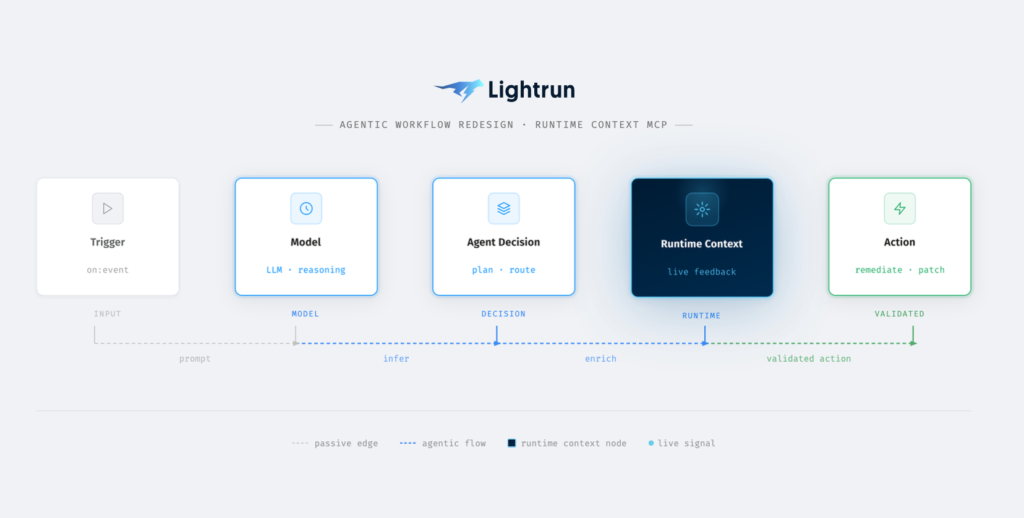
When Lightrun’s Runtime Context MCP is connected as a gate for consequential engineering decisions, every agent in the workflow gains the ability to query what is actually happening in a running production service at the moment it needs to decide: not what happened last time that code path ran, not what the most recent trace shows, but the live execution state right now.
This is a queryable endpoint the workflow calls the same way it does for any other tool. The Runtime Sensor attaches to the running service without redeployment and returns variable values, execution paths, function arguments, and call state at any line. The agent asks a specific question about production. It gets a specific answer.
Lightrun’s Error Remediation Automation Skill shows this pattern in production today. When a connected monitoring source like Sentry, Datadog, or New Relic captures a qualifying error, the skill activates on its own: it maps the failing code path and places a conditional snapshot directly on the running process through Lightrun MCP, capturing runtime evidence at the exact line in question. No redeploy, no developer prompt. A fix is only raised as a PR once the diagnosis is confirmed against live execution state.
In each case the pattern is the same: Model decides → Runtime Context verifies → Action executes. The model stays probabilistic. The verification step is grounded in live evidence. That combination is what makes the workflow reliable.
Why Now Is the Moment to Add In Live Runtime Context
Adding Runtime Context to an agentic workflow you are designing is a single tool connection. Adding it to a finished workflow means revisiting every consequential action point in the graph, confirming the surrounding state management supports live verification, and retesting execution paths that were designed without it. The difference is between connecting a tool and rethinking a system.
The volume of AI-driven engineering changes makes this increasingly urgent. At Vercel’s Ship conference, CEO Guillermo Rauch reported that agent-triggered deployments had grown from under 3% to over 50% of all deployments on the platform in just six months. Every one of those changes that ships without a live runtime verification step is a risk of regression, CVE injection, and code instability.
The rebuild is the window because the foundational decisions are still open: which tools to connect, what state flows where, where approval gates belong. Live Runtime Context belongs in that conversation now, not after v2 ships.
Teams that build the verification layer into v2 will have more dependable agents, engineering resources pointed at growth rather than rework, and a meaningful edge over competitors still debugging the same failure modes v1 introduced.