AI Agents in Finance: Where Do Close Exceptions Come From?
Oct 06, 2026 / Updated: Oct 11, 2026

AI agents in finance can handle routine matching. The exceptions they leave behind are what hold up the close: GL postings that won’t reconcile, intercompany balances that won’t eliminate, and supplier invoices stuck between Ariba and SAP. Most of those exceptions start upstream of the ledger, in the systems around each transaction.
Key Takeaways
- AI agents in finance handle the high-volume work of the close today: invoice capture, PO matching, and first-pass reconciliation.
- The exceptions those agents hand back set the pace of the close. APQC puts the median monthly close at 6.4 calendar days, with the fastest quarter of companies at 4.8 days or fewer and the slowest quarter at 10 days or more.
- Most close and P2P exceptions start in the systems around a transaction: posting rules, the handoff between Ariba and SAP, and master data that drifted between systems.
- An agent that routes an exception to a person clears that one item, and the same cause produces a new one next period.
- Agents that trace each exception to its source and fix the cause with your approval make the queue shorter every period.
What are AI agents in finance, and what can they automate?
In corporate finance operations, AI agents in finance are systems that reason across ERP, bank and sub-ledger data to complete multi-step work in the month end close and procure-to-pay, such as matching invoices to purchase orders or preparing reconciliations, with people approving the outcome. In SAP environments, that work spans SAP, Ariba and the systems connected to them.
The work AI agents for finance do well today is high-volume and rules-heavy:
- Invoice capture and PO matching. Agents read supplier invoices, match them to POs and goods receipts, and post the clean ones.
- Account reconciliation automation handles the first pass: agents match bank, GL and sub-ledger transactions and explain routine differences such as fees and timing.
- Close coordination. Agents track the close checklist, chase owners, and draft variance commentary for review
According to Gartner, three quarters of CFOs are raising their technology budgets for 2026, nearly half by 10% or more, and finance leaders show strong investment intent in AI agents. Despite this, 63% of finance organizations told Gartner that AI implementation moved slower than expected in 2025.
The gap is evident in the exception queue.
Why does the exception queue survive automation?
Matching agents are built to clear clean transactions and pass everything else to a person. The CEO of one agentic AI consultancy described this pattern to ICAEW: an agent matches thousands of invoices to POs and receipts, “isolates only the breaks and drafts the supplier query,” and leaves the accountant to clear them. That approach clears high volumes quickly, and it leaves your team with a fresh list of exceptions to resolve. For a broader look at how bots and agents divide this work, see our guide to RPA vs agentic AI.
Every exception in that queue is a symptom of something upstream. They are the product of a posting rule, an interface between two systems, or a master data record, and the same cause produces another one next period.
APQC’s close research points the same way: most barriers to a faster close come down to data quality, and companies that standardize their chart of accounts finish consolidated statements about two days sooner. Today’s finance agents clear exceptions, so a shorter close starts with knowing where they come from.
Where do close exceptions actually come from?
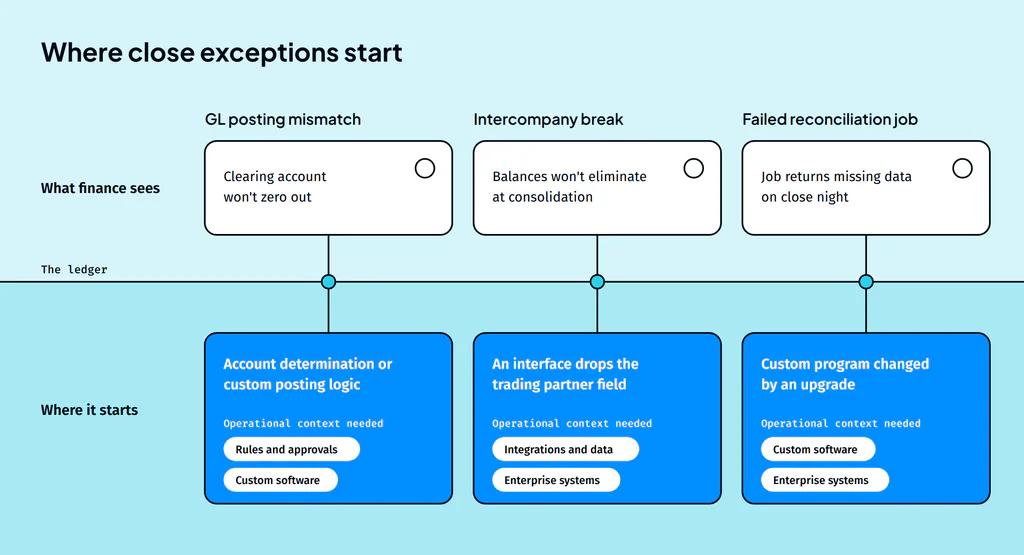
Close exceptions come from the rules, jobs and interfaces that move transactions into the ledger. Three patterns come up again and again in the month end close of SAP environments.
GL posting mismatches
For example, finance sees a clearing account that won’t zero out, or a balance that lands on the wrong GL account and fails reconciliation.
The cause usually sits in posting logic. A change to account determination, or a custom ABAP routine that maps a new document type to an old account, sends every affected posting to the same wrong place. GL reconciliation finds the difference each month, while the rule keeps creating it.
Intercompany reconciliation breaks
A typical case: intercompany balances that refuse to eliminate at consolidation.
The two sides of the transaction were recorded differently. One entity posts on the invoice date and the other on receipt, the entities use different exchange rate types, or an interface drops the trading partner field so one side never links to the other. Intercompany reconciliation tools flag the mismatch, and the person who clears it rarely has access to the interface that caused it.
Reconciliation jobs that fail after an upgrade
For example, a reconciliation or bank statement job finishes with missing data, or fails the night before close.
Upgrades and migrations change tables, interfaces and job sequences. A custom program written for the old structure keeps running and quietly returns less than it should. Teams fresh from an S/4HANA migration often meet this pattern in the first closes after go-live.
Exception
What finance sees
Root cause
Operational context needed to trace it
GL posting mismatch
Clearing account won’t zero out
Account determination or custom posting logic
Rules and approvals, custom software
Intercompany break
Balances won’t eliminate
Posting dates, FX rate types, or a dropped partner field
Integrations and data, enterprise systems
Failed reconciliation job
Missing data on close night
Custom program or interface changed by an upgrade
Custom software, enterprise systems
Where do P2P exceptions come from?
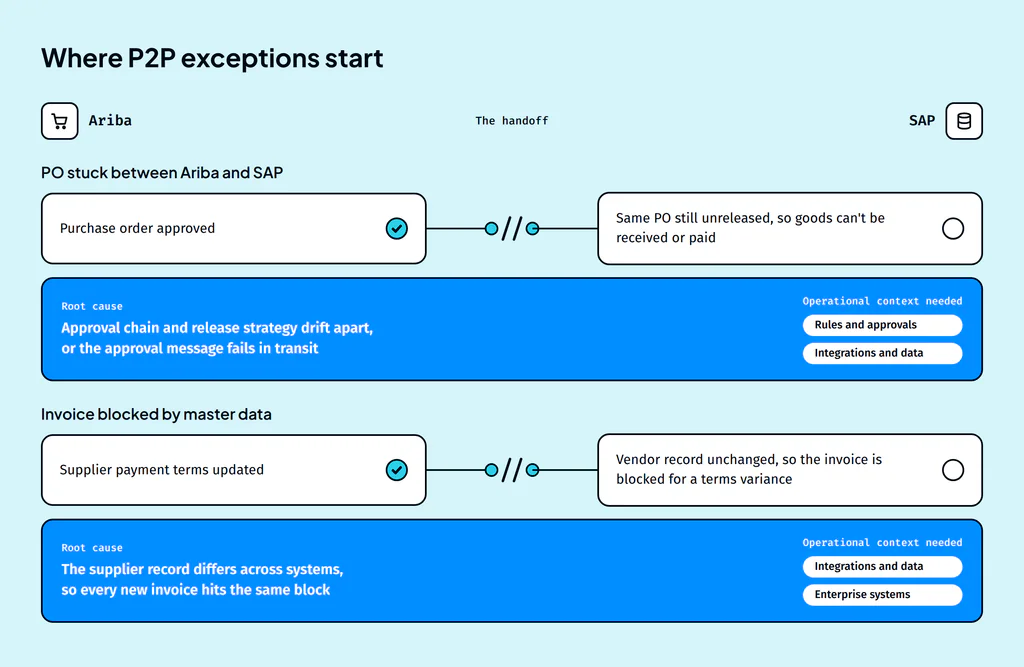
Procure-to-pay exceptions come from the handoffs between procurement and finance systems, and from supplier data that two systems record differently. They delay the close too, because blocked invoices hold up accruals and supplier payments.
POs stuck between Ariba and SAP
For example, a purchase order is approved in Ariba but still unreleased in SAP, so goods can’t be received against it and the supplier can’t be paid.
The approval chain in Ariba and the release strategy in SAP are two separate rule sets. When they drift apart, or when the message that carries the approval fails in transit, the PO waits in a status nobody owns. Buyers chase it by email while the supplier waits.
Invoice exceptions from vendor master data drift
A typical case: AP sees invoices blocked for price, tax or payment-term variances, often from the same handful of suppliers.
Supplier records live in more than one place. Payment terms updated in Ariba, a tax code changed during an S/4HANA cleanup, or a duplicate vendor created by a regional team will each produce a steady stream of blocks. Invoice exception management clears the invoice, and the vendor record keeps producing the next one.
Exception
What finance sees
Root cause
Operational context needed to trace it
PO stuck between Ariba and SAP
Approved PO that can’t be received or paid
Diverging approval rules or a failed integration message
Rules and approvals, integrations and data
Invoice blocked by master data
Repeat price, tax or terms variances
Supplier record that differs across systems
Integrations and data, enterprise systems
How do AI agents resolve exceptions at the source?
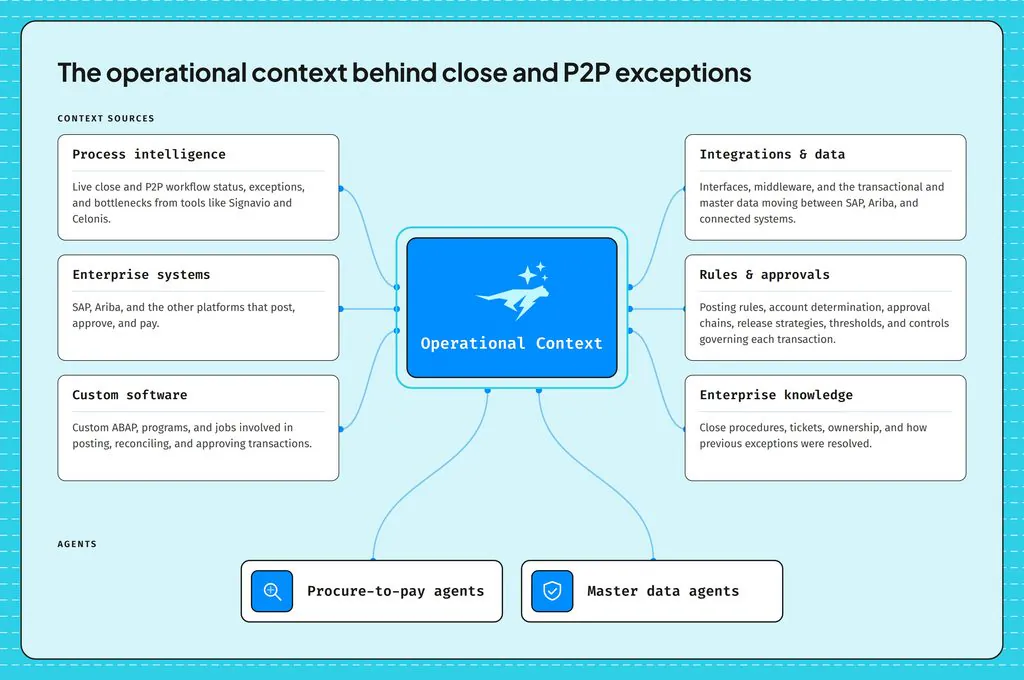
An agent resolves an exception at the source when it sees everything that shaped the transaction: the business rules and approvals, the custom code, the integrations between systems, and the data they exchange. Together, that’s operational context. Lightrun’s business process agents run on operational context, so they trace each exception to where it started and fix the cause with your approval.
The agents apply agentic process automation to the exception path of finance processes:
- Before close, they find GL posting mismatches and failed reconciliation jobs while there is still time to correct them.
- In procure-to-pay, the Procure-to-Pay Resolver clears approval and release bottlenecks holding up POs and traces invoice exceptions between Ariba and SAP.
- Across systems, the Master Data Agent pinpoints where records diverge across connected systems and identifies the transactions and postings the bad data affected.
An example from procure-to-pay. A purchase order is approved in Ariba but sits unreleased in SAP. The Procure-to-Pay Resolver compares the approval in Ariba with the release status in SAP, finds the release step that never completed, and identifies why it stalled. It then proposes releasing the PO and correcting the cause, and a buyer approves both before anything changes. With the cause fixed, the next PO on that approval path releases as expected.
The agents are read-only by default. They investigate and correlate data, and every write action, such as releasing a PO or correcting a record, requires explicit approval from your team. Lightrun’s Forward Deployed Engineers customize the agents to your landscape, including SAP and connected systems, legacy code and non-API platforms, and RBAC and audit logs keep finance in control.
The result shows up in the queue. Each cause an agent fixes removes a recurring source of exceptions, so your exception list gets shorter every period.
How do you measure the ROI of AI agents in finance?
Measure the ROI of AI agents in finance by what changes in the close and in the exception queue, period over period. Gartner advises CFOs to judge their AI portfolio by realized value rather than the number of deployments, and three numbers show that value clearly:
Metric
What it shows
Benchmark
Days to close
Whether the close is finishing sooner
APQC median 6.4 calendar days; top quartile 4.8 or fewer
Repeat exceptions per period
Whether causes are being fixed, or only cleared
Your baseline from the last three closes
Hours spent on exceptions
How much specialist time the queue still takes
Your baseline
Repeat exceptions is the metric most teams skip and the most telling one. Matching agents lower hours on routine work, while a falling count of repeat exceptions shows the upstream causes are getting fixed.
Set expectations on timing as well. In Gartner’s 2026 research, AP and AR automation and report creation generally returned value within nine to ten months.
How do you shorten the close for good?
Close and P2P exceptions come from the operational context around each transaction: the posting rules and approvals that route it, the interfaces that carry it between SAP, Ariba and connected systems, the master data it depends on, and the custom code an upgrade quietly changes. The ledger is only where they surface.
The exception queue outlasts automation for the same reason. AI agents in finance that match and route clear this month’s breaks while the causes keep producing next month’s. A faster close comes from agents that prevent and resolve exceptions at the source. They catch GL posting mismatches and failed reconciliation jobs before close, trace the exceptions that do surface back to the rule, interface or record that caused them, and fix the cause with your approval. Every period then starts with a shorter list than the last.
Lightrun prevents and resolves failures across every layer of your enterprise, from the ledger to the systems, code and data behind it. Book a demo to see how our business process agents keep your close on schedule.
Every exception in your queue
has a cause you can fix.
Lightrun’s business process agents prevent and resolve close and P2P exceptions at the source, across SAP and connected systems.
AI agents in finance operations
AI can be used in finance to capture and match supplier invoices, run first-pass bank and GL reconciliations, and coordinate the close. Customized AI agents in finance go further, keeping cross-platform workflows running across SAP, Ariba and connected systems by preventing the errors that trigger exceptions and resolving the ones that surface.
AI agents in finance work alongside accountants and controllers. The agent handles high-volume matching and investigation, and a person approves postings, payments and record changes. Well-governed agents stay read-only until a person approves an action, and they log every step for audit.
Financial close automation uses software to run month end close tasks such as reconciliations, journal entries and checklist tracking with less manual work. Close tools keep those tasks on schedule, while AI agents in finance work alongside them, preventing the errors behind exceptions and resolving the ones that surface across SAP and connected systems.
Account reconciliation automation matches transactions across bank statements, the general ledger and sub-ledgers, covering GL, bank and intercompany reconciliation. AI agents in finance add value after the match, finding why an exception occurred, such as an interface that dropped a trading partner field, and fixing the cause so it stops recurring.
Yes. AI agents can take on the exception work of SAP financial close automation, across SAP and connected systems such as Ariba. AI agents for finance find GL posting mismatches and failed reconciliation jobs before close, and agents customized to your SAP landscape, including custom code, cover the exceptions that standard close tools leave for people.
AI agents in finance stay auditable through approval steps, role-based access control and full audit logs. Every action an agent proposes is recorded with its evidence, and write actions require explicit approval from an authorized person, so controllers and auditors can see who approved each change and why.
Lightrun’s AI agents prevent and resolve finance exceptions by running on operational context: the rules, custom code, integrations and data around each transaction in SAP and connected systems. The agents catch GL posting mismatches and failed reconciliation jobs before close, and trace the exceptions that do surface back to their source to fix the cause with your approval.