Best PR Review Tools for AI-Generated Code (2026)
Jul 20, 2026 / Updated: Jul 22, 2026


Most PR review tools answer one question: does this code look correct? They scan the diff, flag known patterns, catch security violations, and post inline comments before merge, which is useful, but only half the review. The other half is behavioral: does the code actually behave correctly once it’s running against your live system? At one team’s checkout service, an AI-generated PR quietly rewrote address validation logic, passed every static check, cleared staging, and merged with two approvals. Then, 711 valid orders were blocked at checkout because production traffic carried soft delivery signals staging had never seen. Six of the seven tools below can’t catch that class of failure.
Key Takeaways
- AI coding agents have increased code volume by 180% relative to the pre-agent baseline (NBER, May 2026), and PR review tooling hasn’t kept pace.
- Incidents per PR are up 242.7%, and median time in PR review is up 441%. The probability of a production incident from a merged change has more than tripled
- Google Cloud’s DORA 2025 report finds AI adoption continues to correlate with higher instability, more change failures, more rework, and longer cycle times. Faster shipping hasn’t meant safer production.
- AI static reviewers catch 44% of bugs; the rest reach users. 43% of AI-generated code still needs manual debugging in production after passing QA and staging, eating roughly 38% of developer time per week
- Every tool here falls into one of two buckets: static reviewers that analyze code structure, and runtime verifiers that give AI access to live production context. They don’t cover the same failure modes.
How to Pick the Right Tool
Not all PR review failures look the same, so the right tool depends on which failure category is actually costing your team time and incidents.
| Failure type | What causes it | What catches it |
| Syntax and style violations | Developer inconsistency | Static linters, AI review bots |
| Known vulnerability patterns | Insecure code patterns | SAST tools, security scanners |
| Cross-file logic errors | Bugs in the seams between files and services | Full-codebase-context AI review |
| CVE patch validation | Patch compiles but behaves incorrectly at runtime | Runtime context validation before applying |
| Ticket compliance | PR works but doesn’t solve the requirement | Runtime ticket validation |
| Production behavior failures | Code behaves differently under real traffic | AI with live production context |
If your failures consistently surface after merge and never show up in the diff, the category at the bottom of that table is the one you’re missing, and it’s a different category from everything else on this list.
The 7 Best PR Review Tools in 2026
Before getting into each tool individually, it helps to see where they actually sit. Six of the seven below only ever look at the diff of the code as written, never as run. One takes a fundamentally different approach and examines the code as it behaves under live production traffic. That split matters more than any single feature comparison, so keep it in mind as you read through what each tool catches and where it hits a wall.
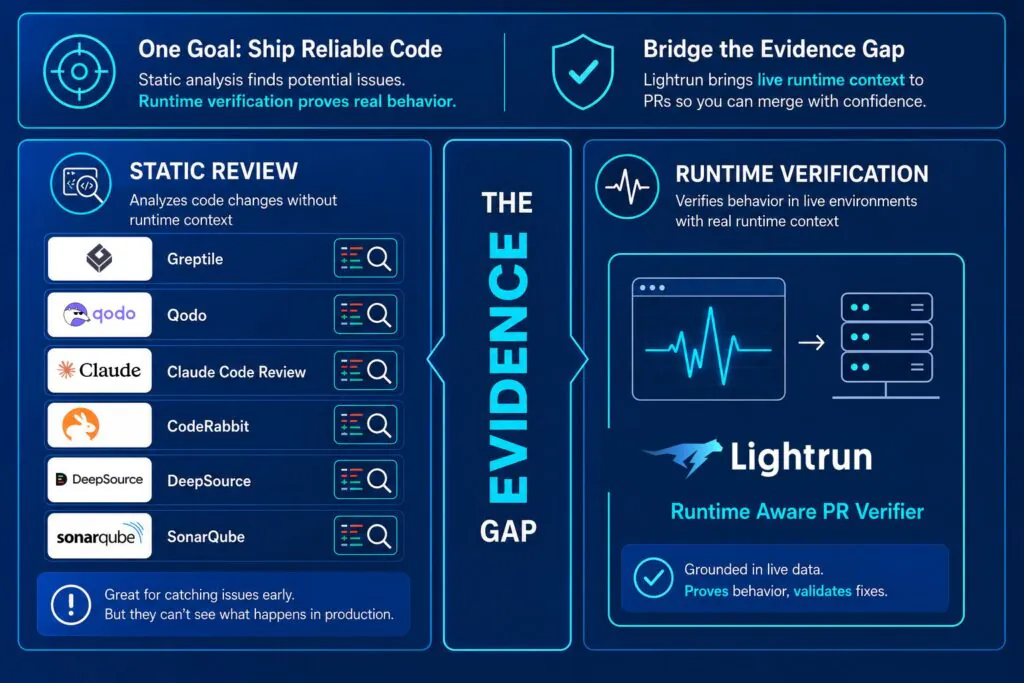
1. Lightrun Runtime Aware PR Verifier
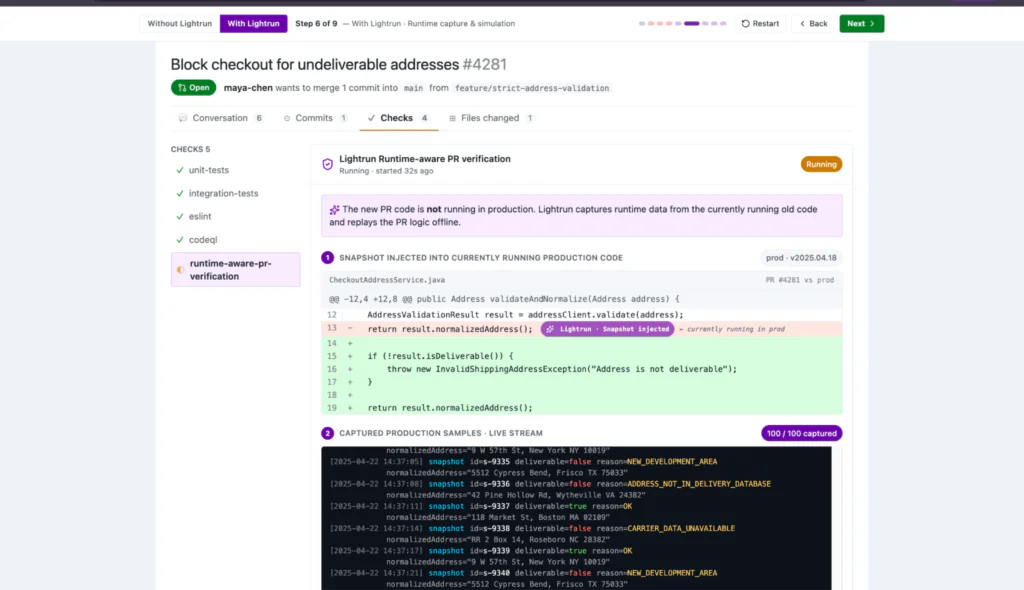
Every other tool on this list reads the code, but Lightrun’s Runtime-Aware PR Verifier gives AI coding agents installed in repos direct access to live production context, so it can simulate how a proposed change will affect the running system before the PR is merged. It also reads the linked ticket to confirm every stated requirement is genuinely delivered at runtime, not just that the change looks structurally sound.
The core mechanism is the Runtime Sensor, a read-only agent that attaches to the currently running production service at the exact line the PR modifies and captures real production traffic samples. AI then runs an offline simulation of the proposed logic on those samples, compares the behavioral outcome with the current production code, and posts the findings directly in the PR before anyone decides to merge. No staging approximation, no synthetic dataset, just evidence from the actual system.
The checkout regression mentioned earlier is exactly this class of problem. The diff looked correct because staging only ever contained hard-failure addresses. The Runtime Sensor captured 100 real production samples, including the soft signals staging never had, and the offline simulation showed the new logic would block 711 valid orders. That signal only exists in production, and only a tool with live context access can surface it.
Four things it catches that no static tool can:
- Production behavior identifies affected code paths and simulates their impact on the live system before the PR is approved.
- Silent regressions: every PR is risk-scored as safe, needs review, or blocked, based on how the change affects live system behavior, dependency interactions, and execution paths under real traffic.
- Ticket compliance reads the linked ticket and validates that each requirement is delivered and edge cases are covered, not just that the change passes review.
- CVE patch validation confirms that a patch behaves as expected in live runtime context, so teams can remediate quickly and correctly the first time, rather than after a second incident.
The Runtime Sensor instruments live execution without side effects it attaches to any running JVM, Node.js, .NET, or Python service with no restarts, no code changes, and no risk to production. Its verification report posts as a native check directly inside GitHub, GitLab, and Bitbucket, so the developer never leaves the PR.
- Hard limit: Logic errors unrelated to environment state and security vulnerabilities in code paths that never execute under real traffic.
- Best for: Teams shipping AI-generated code with downstream dependencies, production-only failure paths, CVE remediation workflows, or any PR that needs to prove it actually solves the ticket.
Verdict: The only tool here that answers the question of whether the code behaves correctly in production. 88% of organizations currently need two to three manual redeploy cycles to verify a single AI-generated fix. Give AI access to live context at review time, and that cycle collapses to one, because the evidence comes from the system itself, not from staging. If your failures happen after the merge, this is the gap the other six tools can’t close. For a full walkthrough of how the checkout regression was caught before merge, see Runtime-Aware PR Review: Validate Code in Live Production.
2. Greptile
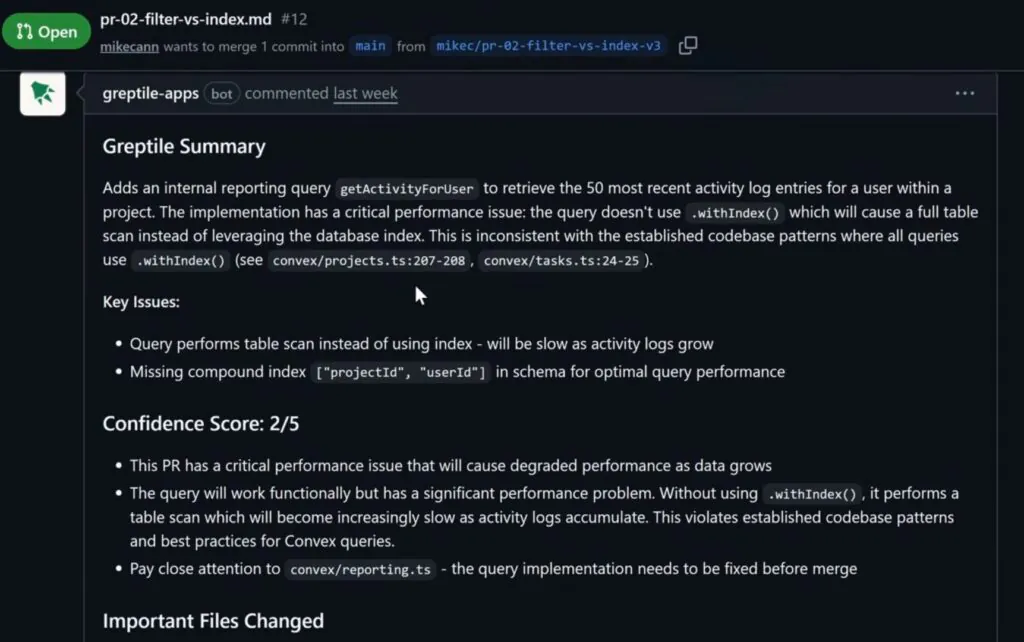
Greptile indexes the entire codebase and reviews each PR against that full context, catching bugs in the seams between files, services, and shared dependencies rather than just what’s visible in the diff. Think of it as the difference between a reviewer who read the one file you changed and one who read the whole codebase, which matters a lot for AI-generated PRs, since an agent writing a setter for a shared field often has no idea how that field is used across a dozen other services. Greptile does. In head-to-head benchmarks across 50 open-source PRs, Greptile catches over 50% more bugs than CodeRabbit.
- Hard limit: Full codebase context, but still static source only. Greptile can tell you a field is used incorrectly across files, but it can’t tell you what value that field holds while real transactions are executing. The diff is the outer boundary of what it can see.
- Best for: Teams whose PRs come from coding agents like Claude Code, Cursor, Codex, and Devin, where agent-generated PRs frequently make subtle assumptions about how a change fits the surrounding codebase.
- Pricing: Free tier with 50 reviews/month and unlimited authors; 50% off for pre-Series A startups; free for open-source projects.
Verdict: The strongest static reviewer for teams shipping AI-generated code at volume. Where most tools see the diff, Greptile sees the whole codebase exactly where agent-authored PRs tend to break. Not a substitute for runtime validation, but the best cross-file static reviewer on this list.
3. Qodo
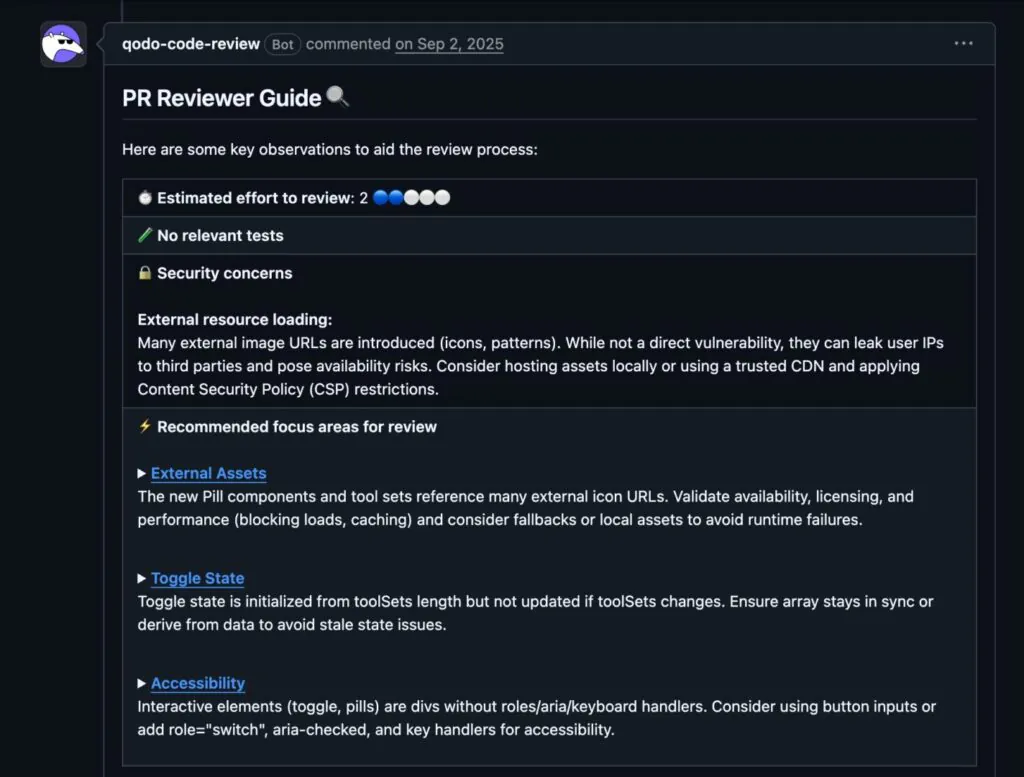
Qodo is an AI code review assistant built around a configurable Rule System, introducing a centralized framework for defining and enforcing engineering standards across repositories.
In April 2026, Qodo transferred PR-Agent to community ownership under the Apache 2.0 license, making it one of the most credible open-source options in the space.
- Hard limit: Strong on static analysis and rule enforcement, but it can’t query execution state or validate behavior in a live system.
- Best for: Teams wanting open-source flexibility with configurable, scalable review rules across multiple repositories.
Verdict: The right choice for teams that want to encode their own engineering standards and enforce them consistently across repos. The April 2026 move to Apache 2.0 makes it a credible open-source pick for teams that can’t or don’t want to pay per seat, though expect some configuration overhead before it produces a reliable signal.
4. Claude Code Review
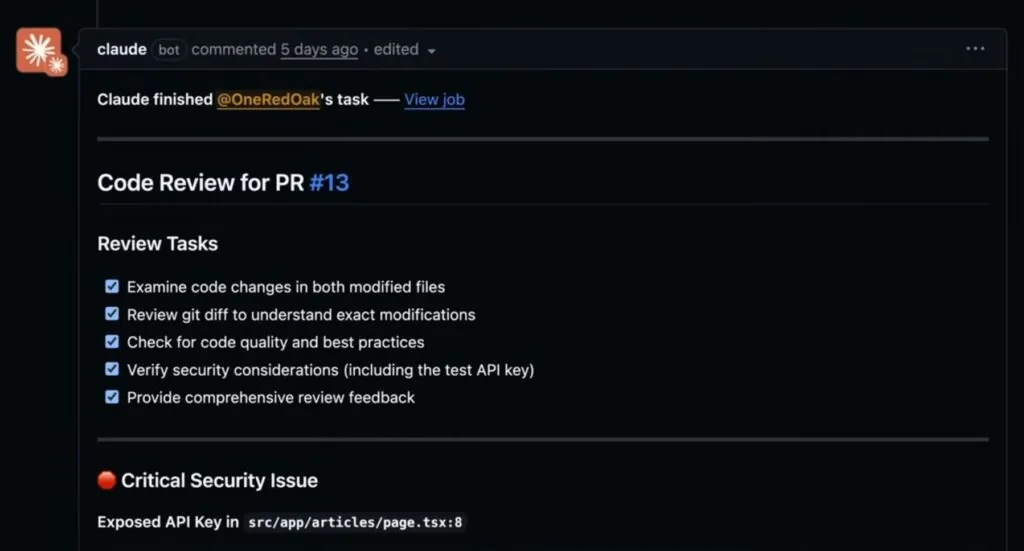
Claude Code Review is a managed, multi-agent PR review system that launched in March 2026 and automatically reviews pull requests as they open on GitHub. It’s available to Team and Enterprise customers as a research preview, bringing Claude’s reasoning directly into the review thread without a separate tool integration. Pricing runs on tokens, averaging $15–$25 per review.
- Hard limit: Static inputs only, and it analyzes the diff and codebase context, but can’t observe live execution state the same architectural wall every tool here faces, except Lightrun.
- Best for: Teams already running Claude Code as their primary coding agent that want native PR review without adding another integration.
Verdict: A natural fit if Claude Code already writes most of your code, one less tool to manage, and review context stays consistent with how the code was written. Per-PR token pricing makes cost less predictable at high volume, and GitHub-only coverage limits reach for teams on GitLab or Bitbucket. Teams that want Claude Code to also see what the code does at runtime can connect to Lightrun’s runtime context MCP.
5. CodeRabbit
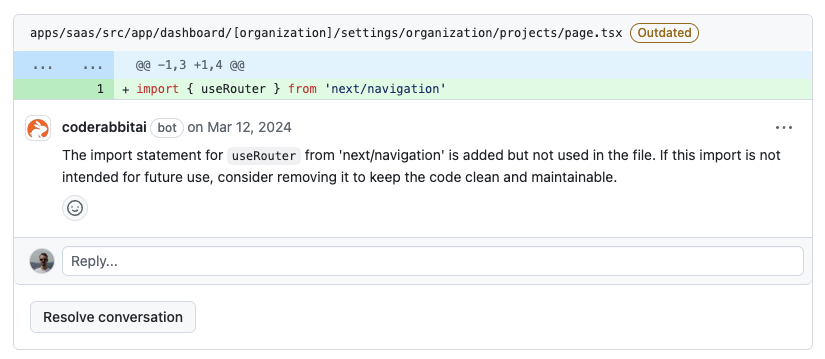
CodeRabbit is an automated PR review tool with contextual understanding of codebase history, style conventions, and PR summaries, one of the most widely adopted AI review tools in 2026, with over 2 million repositories connected and more than 13 million pull requests reviewed.
The free tier includes unlimited public and private repos, PR summarization, 200 files/hour, and a 4-reviews-per-hour rate limit. Pro runs $24/developer/month billed annually, or $30/developer/month month-to-month, counting only developers who open pull requests as seats.
- Hard limit: Strong on codebase history and style consistency, but it operates on static source with no way to query a live environment. It reviews what’s written, not what runs.
- Best for: Teams wanting fast, comprehensive automated PR comments with codebase context out of the box.
Verdict: The easiest entry point into AI PR review: fast setup, solid contextual comments, and a genuinely useful free tier. The right choice if your biggest pain is review throughput and style consistency; not the right choice if your failures happen after merge.
6. DeepSource
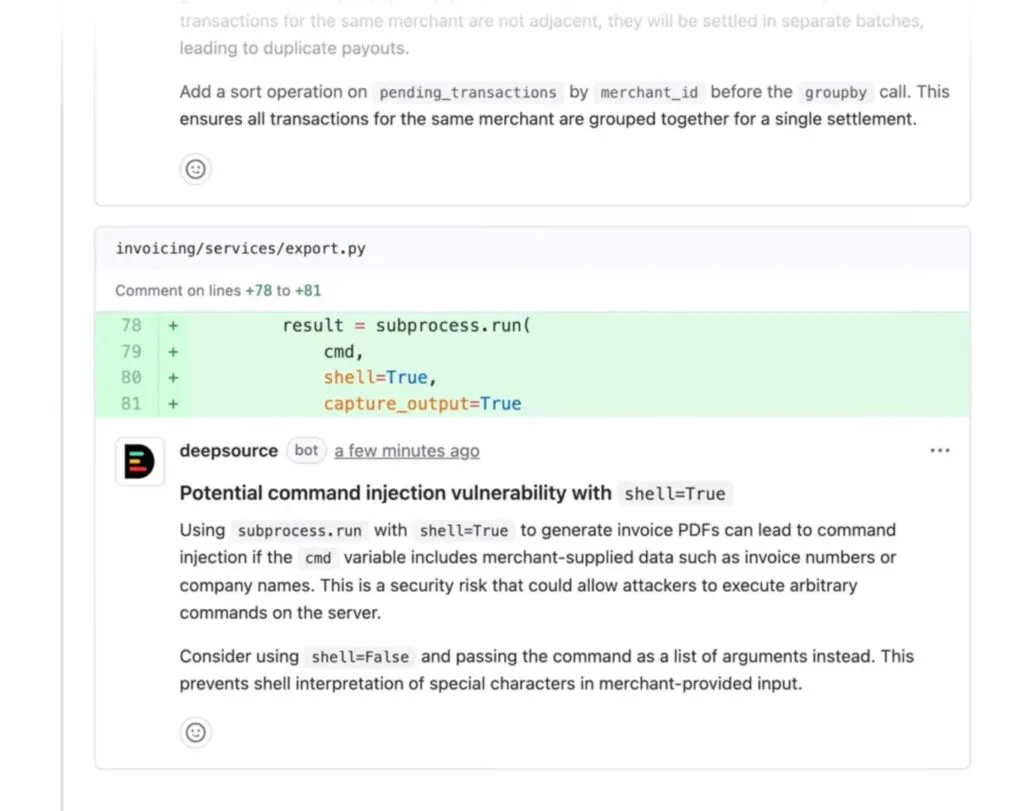
DeepSource takes a two-pass approach: a deterministic static analysis engine runs first across the codebase (5,000+ rules, 30+ languages), then AI review layers on top with full codebase context, data-flow graphs, and taint analysis the most rigorous static-plus-AI hybrid on this list.
On the OpenSSF CVE Benchmark, DeepSource scored an 84.51% F1, the highest of any publicly tested tool here, and it covers secrets detection across 165+ providers. Pricing is $24/user/month annually, with a free tier and setup in about five minutes; no CI pipeline changes required.
- Hard limit: No runtime observation, static and hybrid analysis only. DeepSource can confirm a vulnerability pattern exists in the code, but not whether the vulnerable path actually executes under real production conditions, which is exactly the gap that matters for CVE patch validation.
- Best for: Security-focused teams wanting SAST and AI review in one platform, especially where compliance reporting and CVE tracking matter.
Verdict: The strongest pick for security-focused teams wanting SAST and AI review without stitching tools together. The highest publicly benchmarked F1 score here makes it credible that missing a real vulnerability is worse than a false positive. Pair it with a runtime-aware verifier when your security workflow needs to confirm patches behave correctly at runtime, not just look correct in the diff.
7. SonarQube
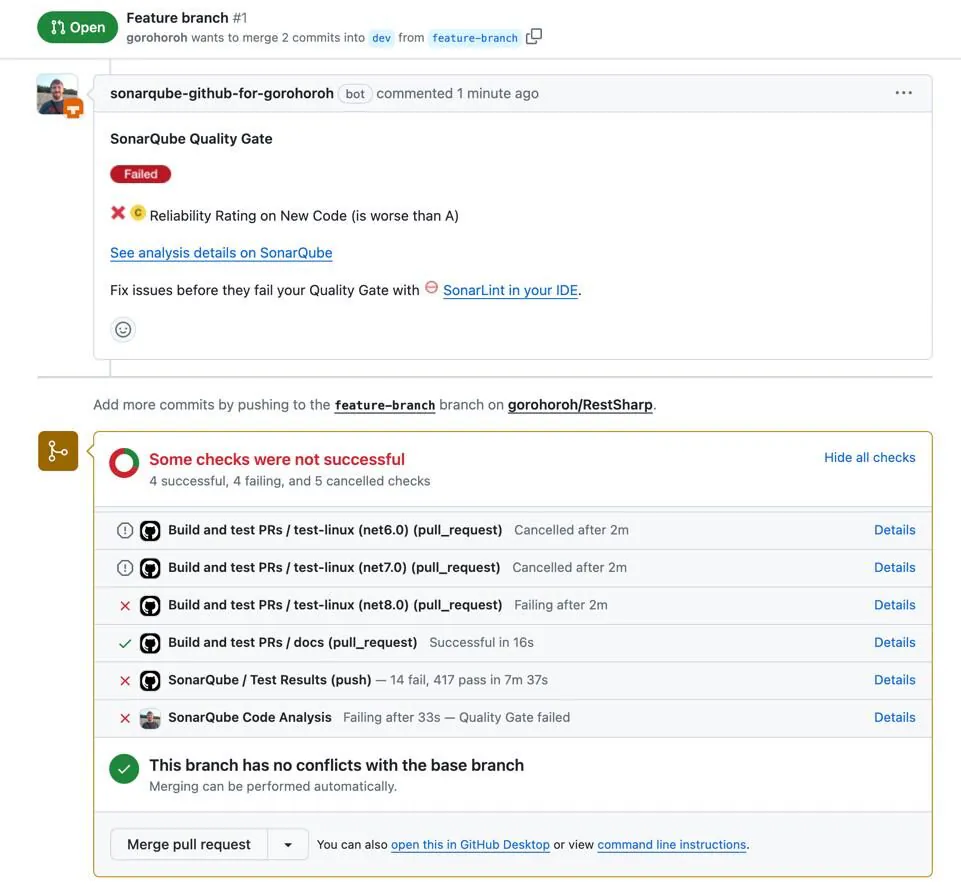
SonarQube remains the most mature open-source option for code quality enforcement, running static analysis across 21 languages. The latest release, SonarQube Server 2026.2, added 14 new FastAPI rules and first-class Groovy support; JDK 21 is now required as of v26.1.0, with Java 17 support ending in July 2026. It has a long-proven enterprise adoption. The Community edition is free; Enterprise pricing is available on request.
- Hard limit: Catches file-level issues but misses how changes affect dependent services; a design-level constraint, not a bug. If a failure only surfaces when code runs against the live production class hierarchy, SonarQube has no path to that signal.
- Best for: Teams with strict security and compliance requirements wanting rule-based enforcement with predictable, low-false-positive output.
Verdict: The default choice for compliance-driven teams that want predictable, rule-based enforcement with no false-positive surprises. Boring in the best way, it’s been doing this longer than anything else on this list. Not the right pick if cross-service behavior or AI-generated code reliability is the core problem.
What Does Each Tool Actually Give You?
| Tool | Review type | Live production context | CVE patch validation | Ticket validation | Platforms |
| Lightrun Runtime Aware PR Verifier | Runtime simulation | Yes | Yes | Yes | GitHub, GitLab, Bitbucket |
| Greptile | AI + full codebase | No | No | No | GitHub, GitLab |
| Qodo | AI + configurable rules | No | No | No | GitHub, GitLab |
| Claude Code Review | Multi-agent AI | No | No | No | GitHub |
| CodeRabbit | AI | No | No | No | GitHub, GitLab |
| DeepSource | SAST + AI hybrid | No | No | No | GitHub, GitLab, Bitbucket |
| SonarQube | SAST | No | No | No | CI/CD pipeline |
Which Tool Matches Your Failure Pattern?
The fastest way to choose is not by comparing feature lists, but by looking at your last five production incidents and asking which category they fall into. Your incident history already tells you which tool you are missing.
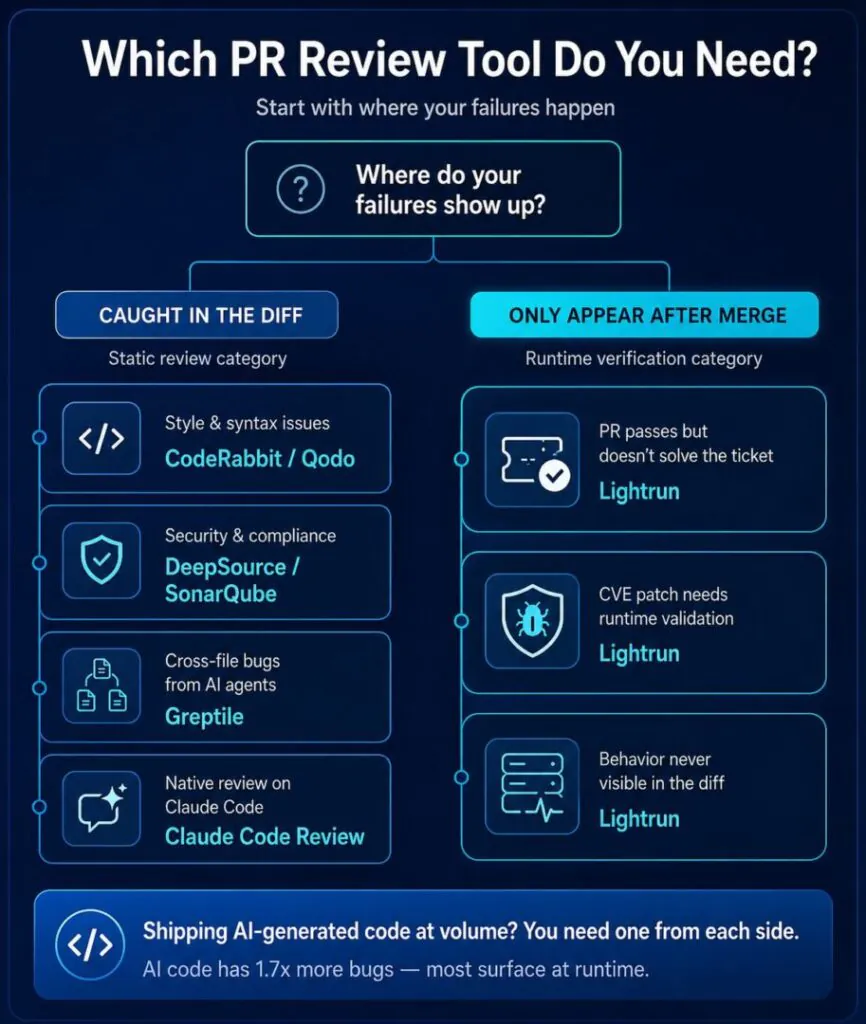
And if you are shipping AI-generated code at volume, you likely need one from each category. AI-generated code contains 1.7x as many bugs as human-written code, and many of those failures only surface at runtime. A static reviewer and a runtime verifier are not competing tools; they cover different halves of the same review.
The Merge Decision Is Only as Good as the Evidence Behind It
Six of the seven tools on this list will tell you what the code looks like. One will tell you what it does. Incidents per PR are up 242.7% in 2026. For every merged change, the probability of a production incident has more than tripled, and it is not a tooling problem in isolation; it’s an evidence problem.
Static review, however AI-augmented, cannot see how a running service responds to a change under real production traffic. The tools that catch style violations and known vulnerabilities are doing their job; they just were not built for the job that matters most right now.
Confirming that AI-generated code behaves correctly in an environment it was never written to understand takes evidence from the system itself. That is exactly what the Lightrun Runtime Aware PR Verifier is built to deliver.
FAQ
It depends on where your failures happen. CodeRabbit or Qodo for style and syntax, DeepSource or SonarQube for security and compliance, Greptile for cross-file bugs in agent-heavy codebases. If your failures only show up after merge, Lightrun Runtime Aware PR Verifier is the only tool built to catch that.
Static review reads the code syntax, logic as written, and known patterns. Runtime verification watches what the code actually does when it runs against a live production context. A PR can pass every static check and still fail at runtime, which is exactly the gap runtime verification closes.
CodeRabbit and Greptile both analyze code that has never run, no matter how much codebase context they pull in. Lightrun gives AI access to real production traffic samples and simulates the PR logic against them as a structural difference, not a feature gap.
Lightrun does that and static tools can confirm a patch looks correct in the diff. Lightrun confirms the patch behaves as expected against live runtime context before it’s applied.
No, the verification report posts directly into the PR alongside existing CI checks, and it typically eliminates redeploy cycles rather than adding new ones.