

Resolve incidents faster with evidence, not guesswork
Lightrun AI SRE is an investigation agent that analyzes instrumentation, changes, and live behavior to prove root causes and resolve incidents before SLAs are breached.
Runtime context from the moment an alert fires
From alert correlation to root cause evidence, structure every investigation so your on-call team spends less time hunting signals and more time resolving.
Investigate from evidence,
not assumptions
Deploy targeted runtime telemetry to any live service when you need it. No redeploy, reproduction, or delay.
Surface root causes,
not signal lists
Correlate logs, metrics, traces, and code behavior into ranked hypotheses. Your team acts on conclusions, not raw data.
Reduce escalations
to engineering
Solve the first layer of investigation before routing to developers. Senior engineers receive evidence, not a description.
How can SREs go from alert to verified fix?
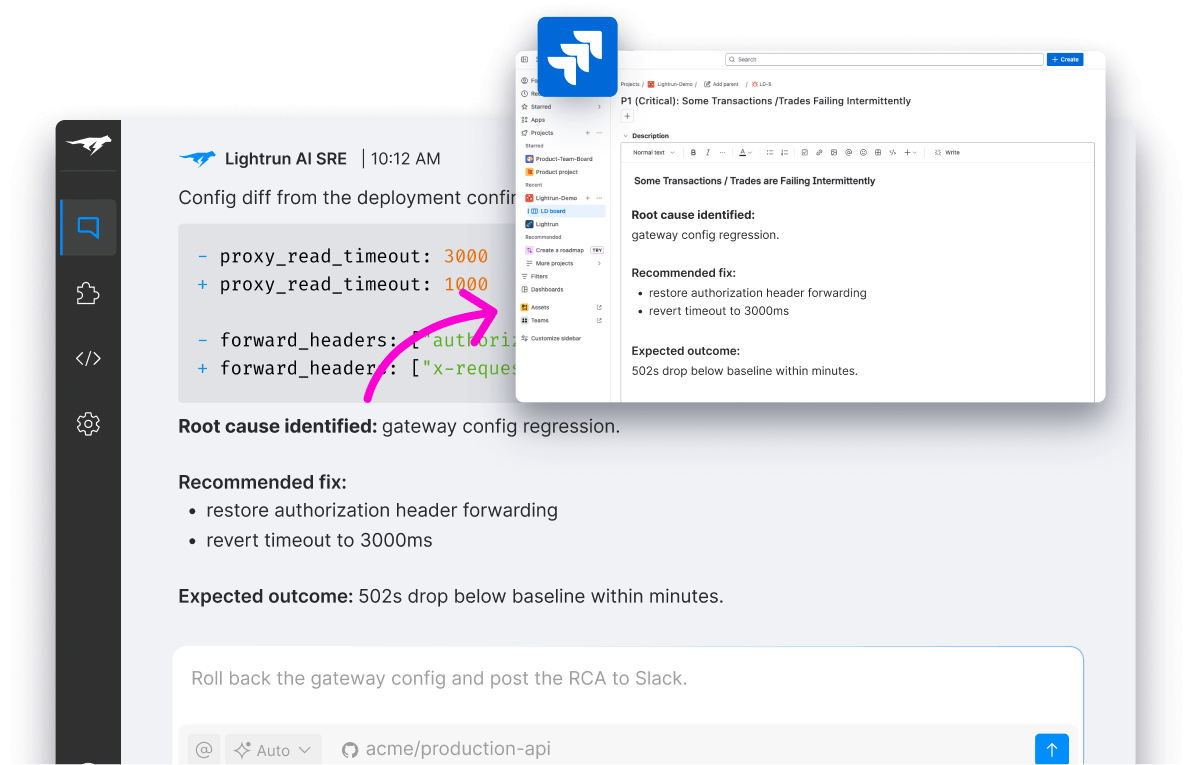
Describe the incident or paste the alert. Lightrun AI SRE analyzes runtime behavior,
identifies the root cause, suggests a fix, and validates the remediation.
Alert correlated with live runtime context
Connect observability signals with live runtime behavior, dependency context, and code-level evidence. Get a clear view of what changed, what broke, and where to investigate first.
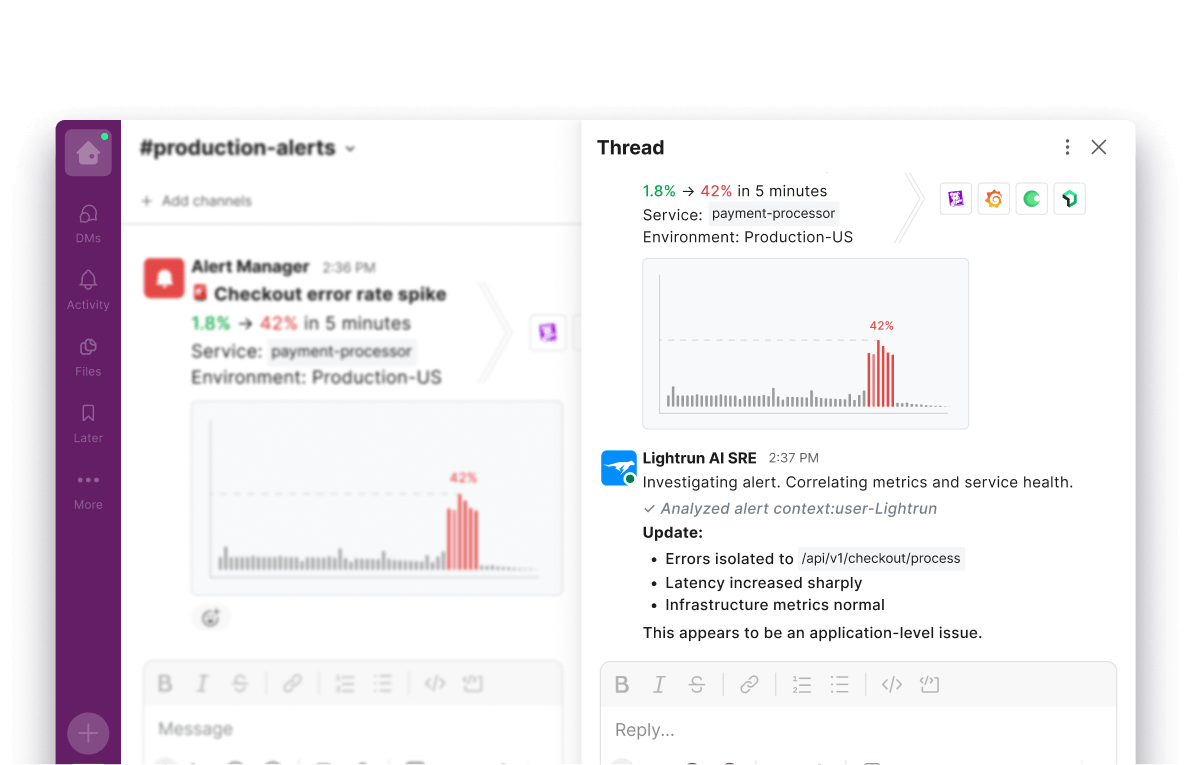
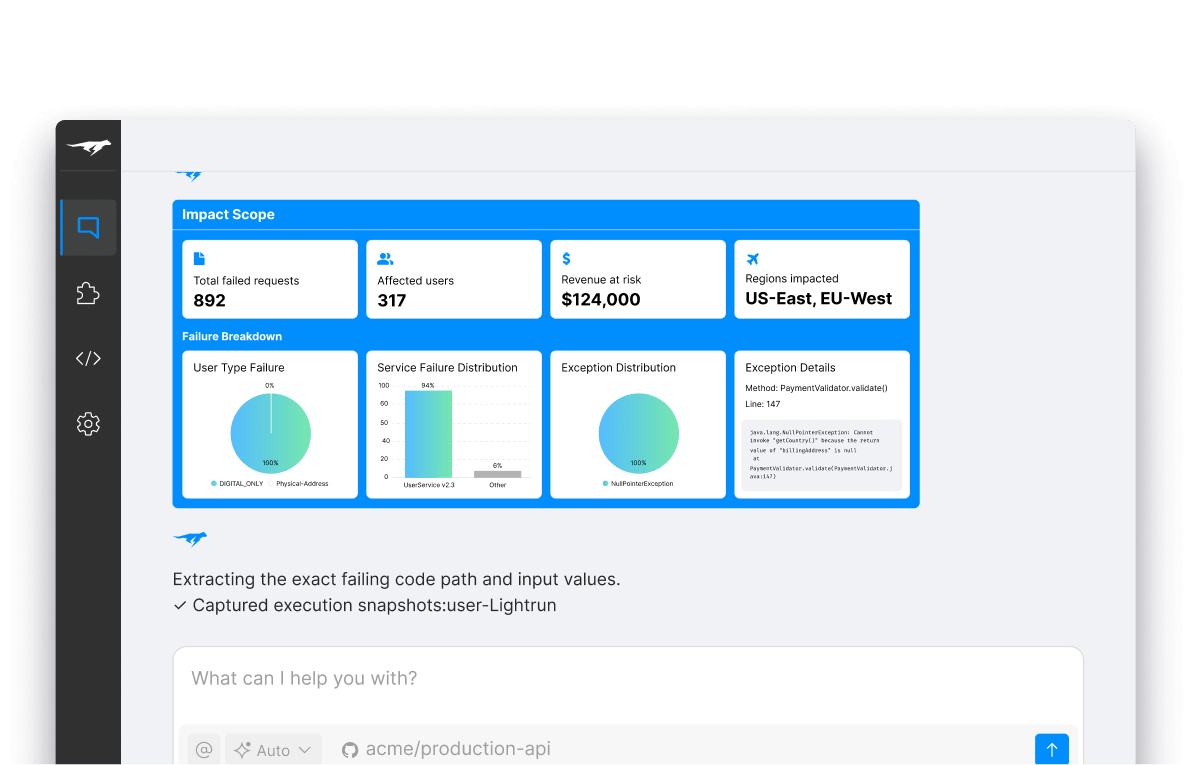
Blast radius and affected services identified
Detect which services are failing and which downstream dependencies are at risk in real time. Prioritize next steps correctly from the first minute, not after manually tracing the call chain.
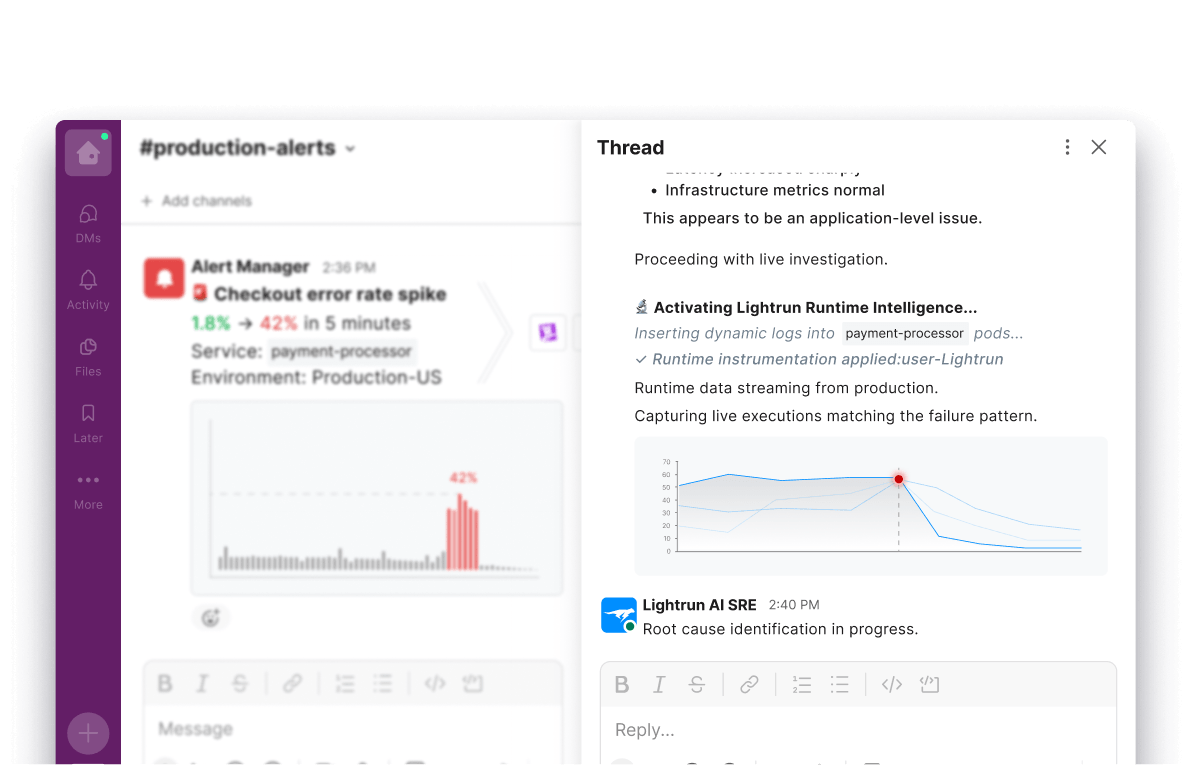
Root cause proven
with live runtime evidence
Lightrun’s Runtime Sensor captures variable state, call stacks, and execution paths at the exact failure point, without a redeploy. SREs can share verified evidence, not a reproduction request.
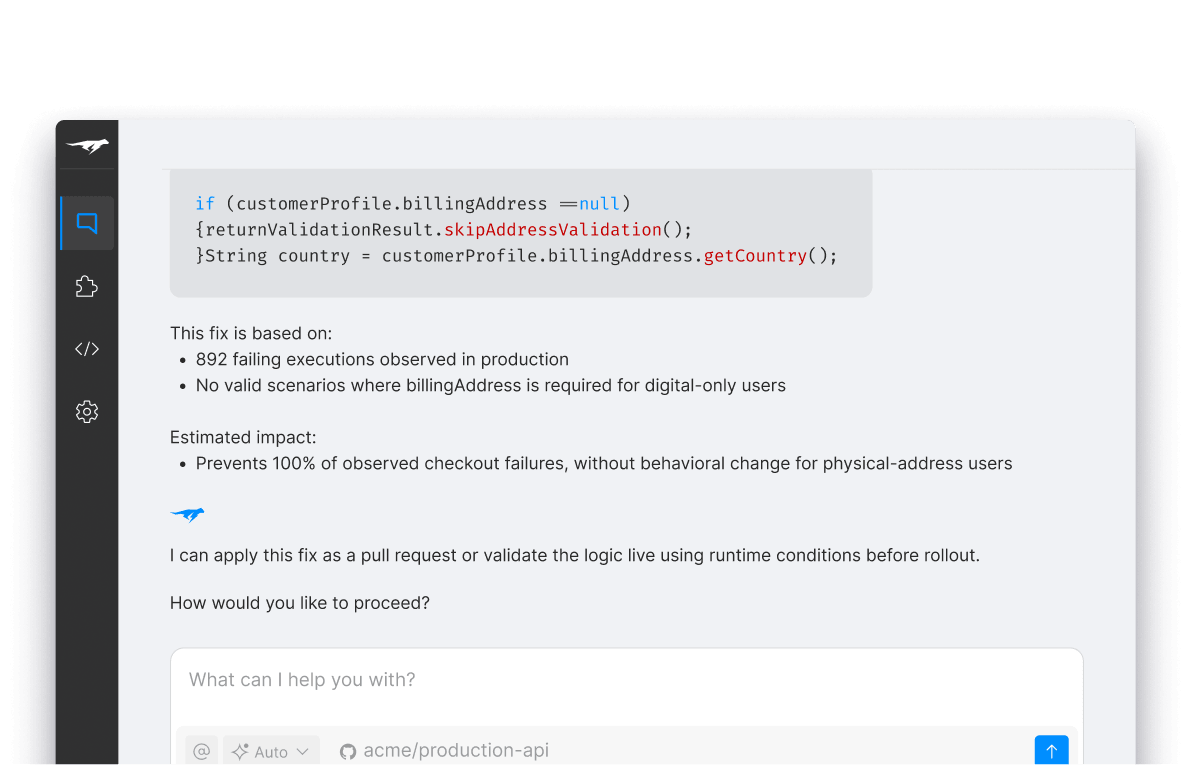
Fixes validated against
production behavior
Lightrun Runtime Sensor confirms the proposed remediation, simulating it with live production behavior before deployment. Your team closes the incident on hard proof.
Incident knowledge
captured for future response
Investigation steps, runtime findings, and root cause evidence are attached to Jira tickets automatically. Runbooks improve with real production evidence, and repeated investigations for recurring issues are eliminated.
“The unique solutions that Lightrun is developing dramatically impact how developers operate.”
Siris Singh, Global Head of Markets Strategic Investments

AT&T reduced Time to Resolve incidents from
5 hours to 30 minutes avoiding costly war rooms

“When it comes to priority-one tickets, customers can’t wait days for a fix. Lightrun helps us reduce that to hours, that’s a huge win for us and for our customers.”
Hood Munaim SVP, Head of Product Engineering

Priceline increased developer productivity
by 30% across workflows over 2000+ services

“Lightrun not only saved us days, if not weeks, of painstaking debugging but provided an efficient approach to tackling complex issues in production.” Tomer Glicksman, SalesForce

Taboola reclaimed 260+ hours of monthly engineering
capacity by eliminating manual reproduction

Inditex engineers used Lightrun’s live, dynamic logs and snapshots directly from their IDE to dig into a critical production issue and uncover a rounding bug quickly.

Drata accelerated incident response velocity by 30% while maintaining strict compliance standards.




Frequently asked questions
AI SRE is an AI-assisted approach to site reliability engineering that helps teams investigate alerts, correlate observability data, identify likely root causes, and accelerate incident response using runtime context and evidence-based diagnostics.
Lightrun reduces MTTR by giving SRE teams live runtime evidence at the moment of failure, no reproduction cycle, or redeployment required. The Runtime Sensor deploys logs, snapshots, and metrics to any running service on demand, correlating that evidence with observability data to surface prioritized root causes. AT&T reduced Time to Resolve from 5 hours to 30 minutes using Lightrun.
No. Lightrun complements tools like Datadog, Dynatrace, and Grafana by adding live runtime context that existing platforms can’t provide. Your observability stack shows aggregated historical signals — Lightrun captures the live variable state and code-level evidence that explains why a failure is occurring.
Runtime context is live, on-demand intelligence about how software is actually behaving in production, not aggregated historical signals, but evidence generated at the exact line of code, at the moment of failure. For SRE teams, it closes the gap between “alert fired” and “root cause confirmed” without waiting for a reproduction cycle or a new deployment.
Lightrun is designed for SRE, platform, and support engineering teams responsible for production reliability at companies running distributed services. It is particularly effective for on-call engineers who need to investigate alerts faster, reduce escalation load, and close incidents before SLAs are breached.