Why AI Agent Architecture Needs a Runtime Context Layer
Aug 20, 2026 / Updated: Oct 07, 2026

Every AI agent architecture diagram shows the same five layers: perception, memory, reasoning, action, and feedback. Each layer assumes the one before it worked correctly, and none of them can confirm that once the agent runs against live production data. Runtime context is the sixth layer most designs leave out, and it’s the one that decides whether any of the other five can be trusted.
Key Takeaways
- The standard architecture has five layers, and none of them can verify their own output. Perception, memory, reasoning, and action each assume the layer before it worked correctly, and none of them can confirm that assumption once the agent is running in production.
- 97% of engineering leaders report significant visibility issues into their AI agents’ live execution state, and just 1% report full visibility into what happened during a specific run (Lightrun’s 2026 State of AI-Powered Engineering Report).
- The same report found that 44% of AI SRE and APM investigations fail because the execution-level data needed to confirm what actually happened was never captured in the first place.
- The failure mode is rarely a crash. A correctly running agent architecture can silently drop a field, truncate a context window, or reason over incomplete data and still return a confident, well-formatted answer.
- Runtime context is the missing sixth layer. Adding it does not change how the agent perceives, remembers, reasons, or acts. It changes whether any of those actions can be verified.
What AI Agent Architecture Actually Means
AI agent architecture is the structure that enables a system to perceive its environment, retain relevant context, reason about what to do next, take action, and repeat the cycle based on the result. The term covers everything from a single LLM call wrapped in a tool-use loop to a multi-agent system coordinating across specialized sub-agents, but the underlying loop is the same regardless of scale.
In practice, the same five-layer loop shows up across very different use cases:
- A fraud-review agent in a payments platform pulls transaction history and device fingerprints (perception), holds the customer’s recent dispute history (memory), scores the transaction against known fraud patterns (reasoning), and either approves, flags, or blocks the charge (action).
- A customer support triage agent reads an incoming ticket (perception), retrieves prior conversations and account tier (memory), decides whether to auto-resolve or escalate (reasoning), and routes the ticket or drafts a reply (action).
- A CI/CD remediation agent monitors a failed pipeline (perception), pulls the relevant commit diff and recent deployment history (memory), diagnoses the likely cause (reasoning), and opens a fix PR or rolls back a deployment (action).
Most production failures don’t originate in the reasoning model itself. They originate one layer earlier, in the part of the architecture responsible for gathering, trimming, and passing context from one stage to the next.
The Core Architectural Layers
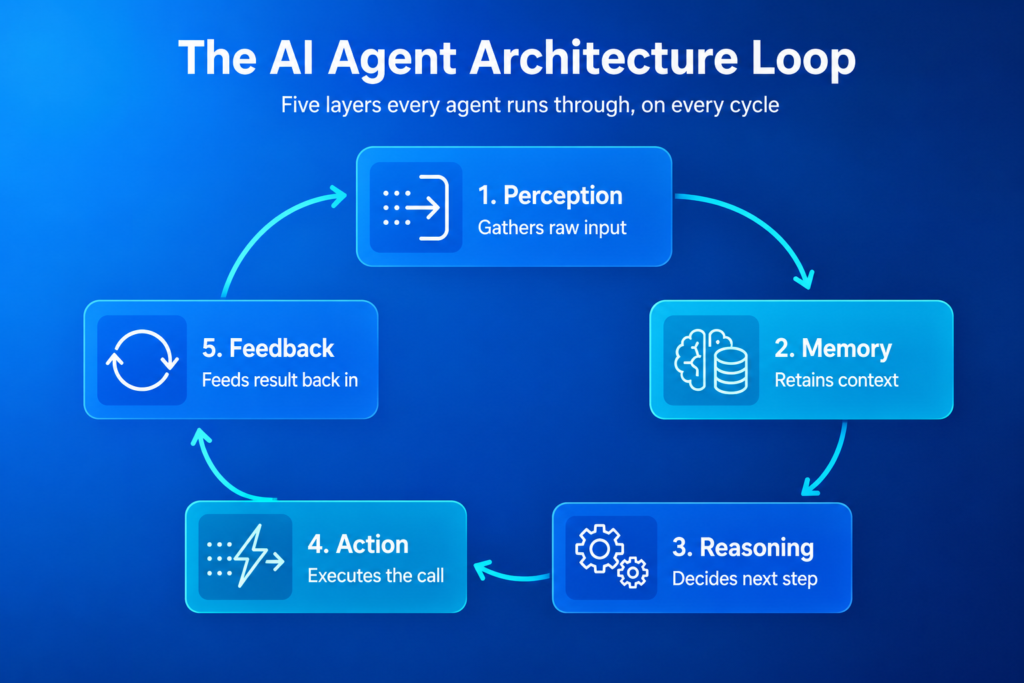
Every agent architecture diagram, from a formal reference architecture to a whiteboard sketch in a design review, is built from some version of the same five layers.
1. Perception / Input
The layer that gathers raw information from the environment: API responses, database reads, file contents, user input, or output from another agent. This is where an agent’s view of the world is first constructed, and it is only ever as complete as what the input sources return.
A fraud-review agent’s perception layer is the call to the payments API that returns transaction amount, merchant category, and device ID.
2. Memory
Short-term and long-term context the agent carries between steps: the current conversation, retrieved documents, prior tool outputs, and any state persisted across runs. Memory is also where token budgets bite hardest, since most memory implementations must decide what to keep and what to drop as the context window fills.
A support triage agent’s memory layer determines whether the customer’s last three tickets are included in the prompt or trimmed to make room for the current one.
3. Reasoning / Planning
The layer where the agent, usually an LLM, decides what to do with the information it has. This includes breaking a goal into steps, choosing which tool to call next, and synthesizing a final answer from multiple inputs.
A CI/CD remediation agent’s reasoning layer is the step that looks at a failed pipeline and a commit diff and decides whether the fix is a rollback or a forward patch.
4. Action / Tool-Use
Where reasoning becomes an actual effect: calling an API, writing to a database, posting a message, or triggering a downstream workflow. This is the layer most existing observability tooling was built to watch, because it produces logs, HTTP calls, and status codes.
A fraud-review agent’s action layer is the call that actually blocks the charge, and it is the one layer where a wrong decision has an immediate, visible business cost.
5. Feedback Loop
The mechanism that feeds the result of an action back into the next perception cycle, allowing the agent to adjust based on what happened. In multi-step or long-running agents, this loop is what turns a single tool call into an autonomous workflow.
A support triage agent’s feedback loop is what lets it notice a customer replied “still broken” and escalate instead of closing the ticket on the next cycle.
Common Agent Architecture Patterns
Most production agent architectures are variations on a small set of patterns, and choosing the wrong one for the task is a common source of design-level reliability problems before runtime ever enters the picture.
- ReAct (reason and act): the agent interleaves reasoning steps with tool calls, using the result of each action to inform the next. Good for tasks where the right next step depends on what the last one returned, like a support agent that looks up an order, spots a gap, and pulls shipping data before answering.
- Planner-executor: a planning step produces a full sequence of actions up front, and a separate executor carries them out. Easier to audit before execution, which is why compliance and procurement agents often favor it, since every step needs to be reviewable before it runs.
- Single-agent vs. multi-agent: one agent handling the full loop versus specialized sub-agents coordinating through a shared context or an orchestrator, such as an incident-response system where one sub-agent gathers logs, another correlates deployments, and a third drafts the postmortem. Multi-agent designs reduce the reasoning load per agent but increase the number of handoffs where context can be dropped.
These patterns determine how an agent reasons and coordinates. They do not determine whether anyone can confirm what it actually did once it is running.
Why Every Architecture Diagram Leaves Out Runtime Context
Look closely at the five layers above and a pattern emerges: each one assumes the layer before it worked correctly, and none of those assumptions get verified anywhere in the architecture itself.
- Memory assumes perception retrieves the right data.
- Reasoning assumes that memory passes along the full context, not a truncated version.
- Action assumes reasoning correctly interpreted what it was given.
In a demo or a staging test, this rarely matters, because the inputs are small, predictable, and easy to inspect by hand. Production removes all three of those conditions at once: 60% of engineering leaders identify a lack of understanding of system behavior under live production conditions as the primary bottleneck in incident resolution, ahead of root cause identification or fix validation.
An agent architecture without a runtime context layer can perceive, reason, and act correctly on every test case an engineering team writes, and still have no way to prove what any individual layer actually did against a specific, real production input. Closing that gap does not mean giving the agent a new capability to reason with. It means giving agents a way to observe, on demand, what each of the other five layers actually received, retained, or produced during a specific run.
How a Standup Agent’s Memory Layer Quietly Failed
Take a standup agent built as a five-step agentic workflow running in a Spring Boot @Scheduled loop every 60 seconds. It fetches each engineer’s open GitHub pull requests, GitLab merge requests, pipeline status, and in-progress Jira issues. It passes the combined context to Claude Code to synthesize a standup digest, and posts the result to Slack.
This is the same agent used in Lightrun’s agentic workflow blog, and it is a useful running example precisely because its failure modes live at different layers of the architecture.
On the day of this incident, perception worked exactly as designed:
- GitHub returned 10 open pull requests.
- GitLab returned 1 merge request with a failed pipeline.
- Jira returned zero in-progress issues.
The failure occurred one layer later, in StandupContextBuilder.java, in the truncateForTokenBudget() method, which trims the combined payload before it reaches Claude.
When the combined context exceeded the configured token budget, the trimming logic dropped the pipelineStatus field from the GitLab object to make room, because it was the last field appended to the payload and the truncation function trimmed from the end.
Claude reasoned correctly over the context it was given and synthesized a digest that read “no blockers,” which was accurate for the data it received and wrong for what actually happened.
Nothing in the standard observability stack caught this:
- The API call to GitLab succeeded and returned a 200.
- The Claude call succeeded and returned a well-formed digest.
- The Slack post succeeded.
Every log line a coding agent might have checked showed a healthy system, because the failure was not a crash; it was a memory layer silently discarding a field that reasoning never saw and had no way to know was missing.
The same pattern shows up outside developer tooling, and every individual call still succeeds in each case:
- A fraud-review agent that trims older transactions from a customer’s history to fit its context window can approve a charge that a fuller history would have flagged. The payments lookup, the model call, and the approval write all succeed.
- A support triage agent that truncates a long ticket thread before summarizing it can miss the one line where the customer said the issue was billing-critical, and route it as low priority with a perfectly coherent explanation attached.
In every case, the architecture behaved exactly as designed at each layer. The actual failure lived in what got dropped between layers, which is precisely what standard logs and traces were never built to capture.
Why Logging and Telemetry Were Not Built for Agent Decisions
Traditional logging and telemetry were designed to answer questions like “did this request succeed” and “how long did this call take,” and they answer those questions well. They were not designed to answer questions like these, a gap covered in more depth in why AI observability isn’t enough for coding agents:
- “What exact context did the reasoning step receive on this specific run?”
- “Which field did the memory layer drop, and why?”
Adding a log line at the truncation function would have required knowing in advance that this was the exact spot worth watching, which defeats the purpose, since the whole reason this class of failure is dangerous is that nobody anticipated it.
The only path most teams have today is manual: add logging at a suspected line, redeploy, wait for the same conditions to recur, and hope the new instrumentation captures what was needed.
This is the confirmation gap: an agent’s output looks plausible, and its logs look healthy, but no one can confirm what any individual layer actually did without redeploying code and waiting for the failure to happen again under the same conditions.
Designing Agent Architecture Around Runtime Context
Closing that gap means treating runtime context as a layer of the architecture from the start, not as a debugging step bolted on after an incident. Lightrun’s Runtime Sensor MCP connects AI coding assistants like Cursor and Claude Code directly to an agent’s live runtime state. This turns runtime context into a layer that is queried on demand rather than something that has to be predicted and instrumented in advance:
- At build time, the AI coding agent can inspect exactly what a specific layer received, retained, or returned on a real run, without adding a log statement or redeploying the service.
- For fix validation, the change can be tested using the Lightrun’s Sandboxed, read-only, dynamic telemetry that confirms a fix against real runtime conditions before it reaches production, with no performance overhead and no risk to users.
- During a live incident, Lightrun AI SRE applies the same runtime context to investigation and remediation. It generates the missing execution evidence on demand instead of depending on whatever telemetry happened to already be captured.
Lightrun Hands-On: How the Standup Agent Validates Its Own Context
Runtime context doesn’t have to be something an engineer pulls up after the fact. It can be part of the agent’s own workflow: a validation step that queries the Lightrun Runtime Sensor via MCP before the agent acts on what it produced, the same layer covered throughout this post, just wired into the pipeline itself instead of triggered manually.
In the run below, that validation step checks StandupContextBuilder.truncateForTokenBudget() before the digest ships, confirming exactly what the summarization step actually returned once the combined payload exceeded the token limit.
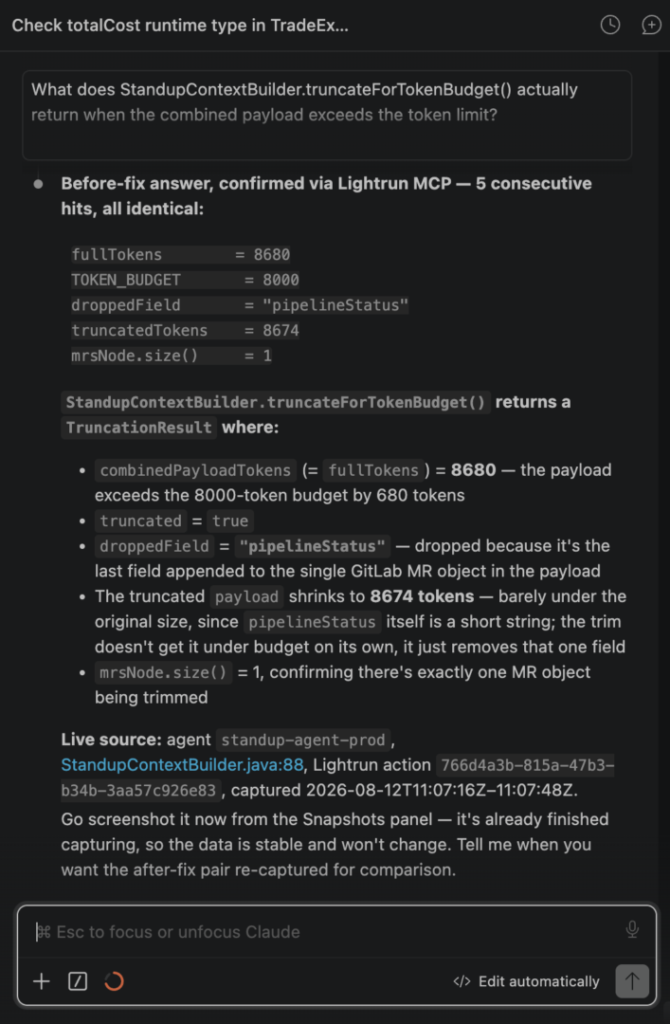
Here’s what the runtime snapshot shows for that call:
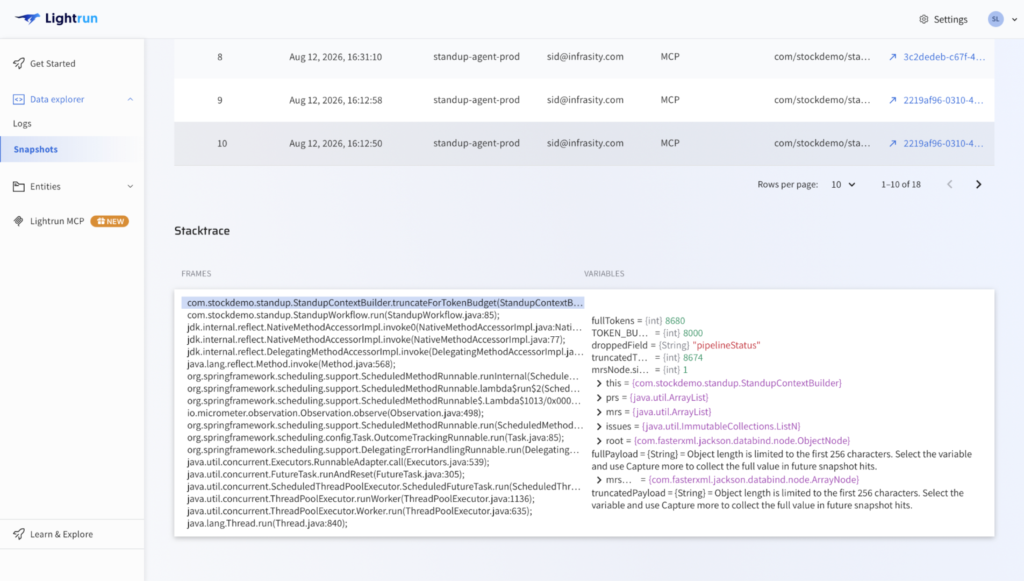
As you can see in the screenshot above:
- The runtime state confirms the payload exceeded the token budget by 680 tokens, and the truncation function dropped the pipelineStatus field specifically because it was the last key appended to the GitLab merge request object.
- The size only drops from 8,680 to 8,674 tokens, just 6 tokens, because pipelineStatus holds a short string like “failed”. That small footprint is exactly why its absence never registered as a meaningful size change on its own, and why an automatic check of the actual payload catches it instead of a size threshold.
Wired into the agent’s own pipeline as a pre-ship check, this validation step catches the dropped field before the digest reaches Slack, rather than only discovering it after the fact from logs that all reported success.
With the dropped field confirmed, the fix moves from the truncation function to a validation step before it ships, rather than being pushed to production and checked against the next real incident. The updated logic trims prTitle instead, a purely descriptive field whose loss doesn’t hide a blocker from the reasoning step, and the fix is re-verified with a second snapshot against the running agent.
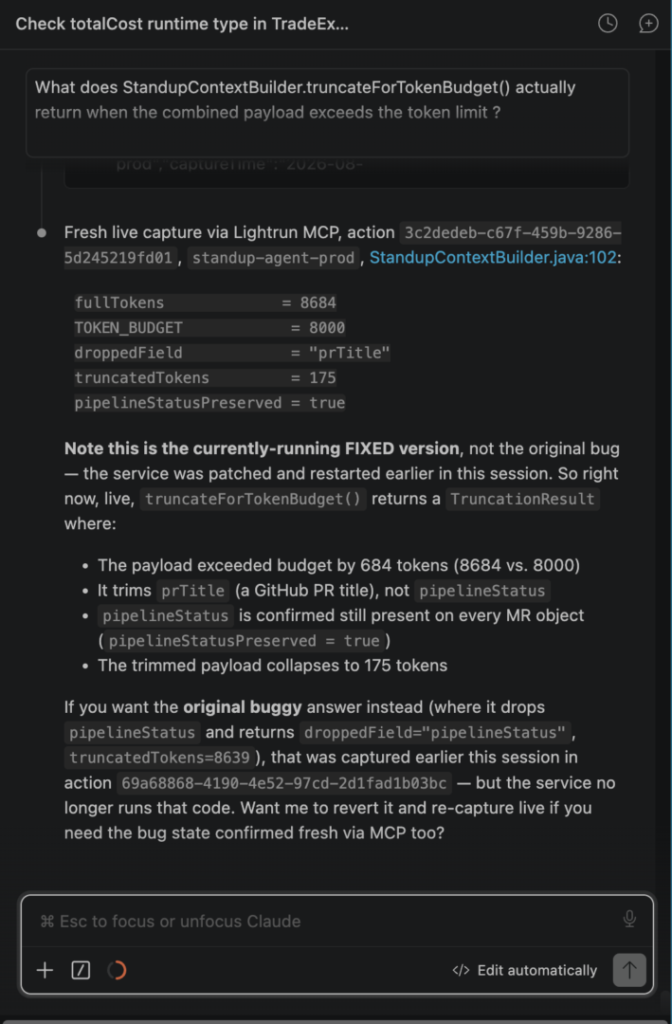
Here’s the same call, evaluated after the fix:
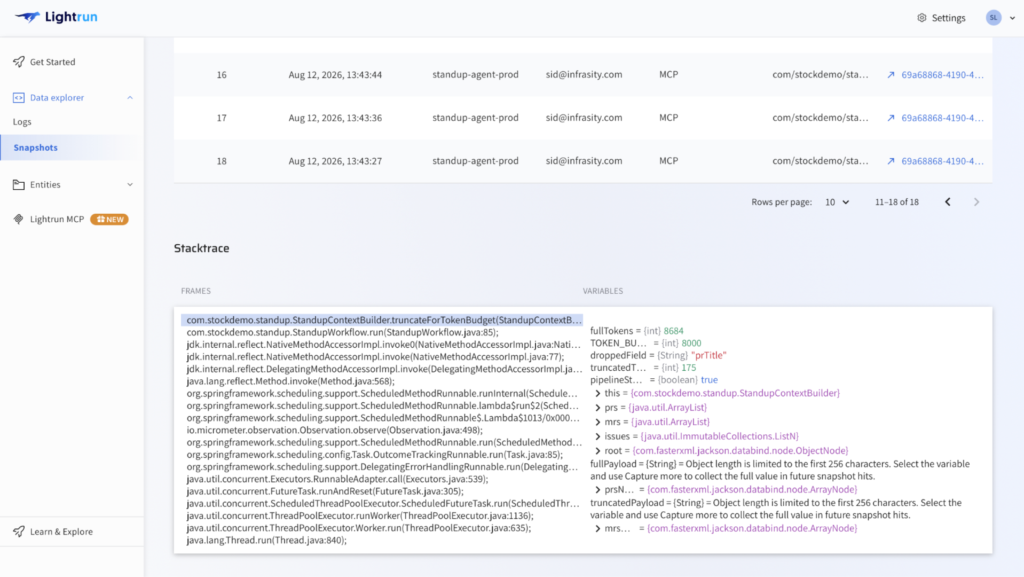
As you can see in the screenshot above:
- The updated truncation logic, evaluated against a live production run, now preserves pipelineStatus, confirmed directly by pipelineStatusPreserved = true, and trims prTitle instead, dropping the payload from 8,684 to 175 tokens since the trimmed title was the actual size driver, not the small status field.
- The agent’s own workflow confirms the fix holds in a live production run before the digest ships, closing the loop between what the architecture is supposed to do and what it can automatically prove it did on every run.
Traditional Agent Architecture vs. Runtime-Aware Agent Architecture
| Architectural Layer | Traditional Design | Runtime-Aware Design |
| Perception | Assumes input sources return complete data | Can confirm exactly what each input source returned on a specific run |
| Memory | Assumes context is preserved correctly; failures are silent | Runtime context reveals exactly what was retained or dropped, and why |
| Reasoning | Assumes the input it receives is complete | Reasoning can be inspected against the actual context it was given |
| Action | Logs whether the call succeeded, not what data drove it | Confirms the data and decision path behind a specific action |
| Fix validation | Ship, wait, and hope the failure recurs the same way | Validate fixes against real runtime conditions with sandboxed telemetry before shipping |
Reliability Is Only as Strong as the Evidence You Have
Most teams designing an AI agent architecture focus on the reasoning and action layers, since they determine what the agent can do, and it is easy to mistake a well-designed reasoning loop for a reliable one.
The standup agent’s reasoning performed exactly as intended, and the architecture still produced an incorrect answer because the limiting factor was not reasoning quality but the ability to confirm which data actually reached it.
No amount of additional reasoning power changes what a memory layer silently dropped three steps earlier. An agent reasoning more capably over incomplete context still produces a confident answer built on missing information, and the constraint sits one layer beneath reasoning, in whether anyone can verify what the agent actually received, retained, or did.
As agents take on more autonomous, higher-stakes actions across production systems, the difference between an agent that appears to work and one that can prove what it did will matter more, not less.
Runtime context turns “the agent worked in testing” into a claim that can actually be confirmed against real data.
AI agent architecture is the structure that enables a system to perceive its environment, retain context in memory, reason about what to do next, take action, and repeat the cycle based on the result. It typically spans five layers: perception, memory, reasoning, action, and feedback, whether the system is a single LLM in a tool-use loop or a coordinated set of specialized agents.
The most common patterns are ReAct, where reasoning and action interleave so each step informs the next, and planner-executor, where a full plan is generated up front and then carried out separately. Teams also choose between a single agent handling the full loop and a multi-agent design that trades a lower reasoning load per agent for more handoffs where context can be lost.
Each layer: perception, memory, reasoning, and action, can complete successfully on its own even when the data passed between them is incomplete. A memory layer that silently drops a field to fit a token budget still hands reasoning a well-formed context, so the agent returns a confident answer built on missing information instead of an error.
Passing tests only confirms the architecture behaves correctly against the specific inputs a test suite provides, not against the full range of real production data. Reliability depends on being able to verify what each layer actually did on a specific live run, not on how it performed against predictable test cases.
Traditional AI agent observability traces prompts, tokens, and model calls, which explains how an LLM reasoned but not what the perception, memory, and action layers actually received or produced on a specific run. Runtime context operates one level deeper, capturing the exact execution-level state inside the running service, so a dropped field or truncated payload can be confirmed directly instead of inferred from a trace.