How AI Helps Change Advisory Board Keep Up With Today’s Demands
Oct 08, 2026 / Updated: Oct 08, 2026

The change advisory board (CAB) agenda is filling up with migration transports, support package stacks, ECC-to-S/4HANA retrofits and new AI integrations. The board still needs to judge each change’s risk, but rising volume pulls the team into assembling evidence. AI agents with full operational context can take on that work, mapping what each change touches across the estate and scoring its risk, so the board can focus on judgment.
Key Takeaways
- A change advisory board (CAB) reviews proposed changes based on risk, impact and timing, and either advises the change authority or acts as the change authority itself.
- Changes follow three paths: standard (pre-approved), normal (assessed and approved) and emergency (expedited, often through an emergency CAB).
- ITIL 4 places change authority at the level appropriate to each change’s risk, and many organizations keep a CAB as that authority for high-risk normal changes.
- Migrations, upgrades and new AI systems are adding change volume, and DORA’s 2025 research finds that AI amplifies an organization’s existing strengths and weaknesses, a good reason to reassess change controls.
- A risk-scored briefing for every change lets the CAB spend its time on judgment, with AI agents preparing the evidence and people making the decisions.
- AI fits safely into a CAB when agents prepare the evidence and people keep the decisions: read-only by default, explicit approval for every write action, and a full audit trail.
What is a change advisory board?
A change advisory board (CAB) is a group that reviews proposed changes to IT services and systems, weighing each change’s risk, impact and timing. In some organizations, the CAB advises a separate change authority. In others, the CAB itself has authority to approve or reject changes.
In an SAP landscape, a CAB may review a custom code transport, a support package stack or a new interface before it reaches production. Its job is to catch the change that looks routine on paper but touches something critical: a pricing routine that also feeds the warehouse interface, or a kernel update scheduled for the night of the month-end close.
ITIL 4 sizes approval to the risk of each change
ITIL, the most widely used IT service management framework, made the CAB a standard part of change management. ITIL 4 renamed the practice change enablement and replaced the default CAB with a change authority, chosen by each change’s risk. As ITSM.tools explains, that authority can be a delegated team, a peer reviewer or an automated pipeline.
In practice, many organizations keep the CAB as the change authority for high-risk normal changes and delegate the rest. The useful question for any AMS or Basis team is which changes actually require the full attention of the board.
Who should be on a change advisory board?
A CAB works when every system and process a change can affect is represented by someone at the table. As a result membership flexes with each change, but a core group usually looks like this:
Member
What they check
Change manager (chair)
Process, schedule and conflicts between changes
Application and service owners
Functional impact and test results
Basis
Transport sequencing and predecessors, import windows, kernel and support package dependencies, system availability
Integration
Interfaces and downstream systems the change touches
Security
User impact and communication
Service desk
User impact and communication
Business process owners
Timing against month-end close and other critical periods
In many SAP landscapes, Basis teams coordinate production imports. They often know the import order, predecessor transports and system windows better than anyone else in the room.
An emergency CAB decides changes that need approval before the next meeting
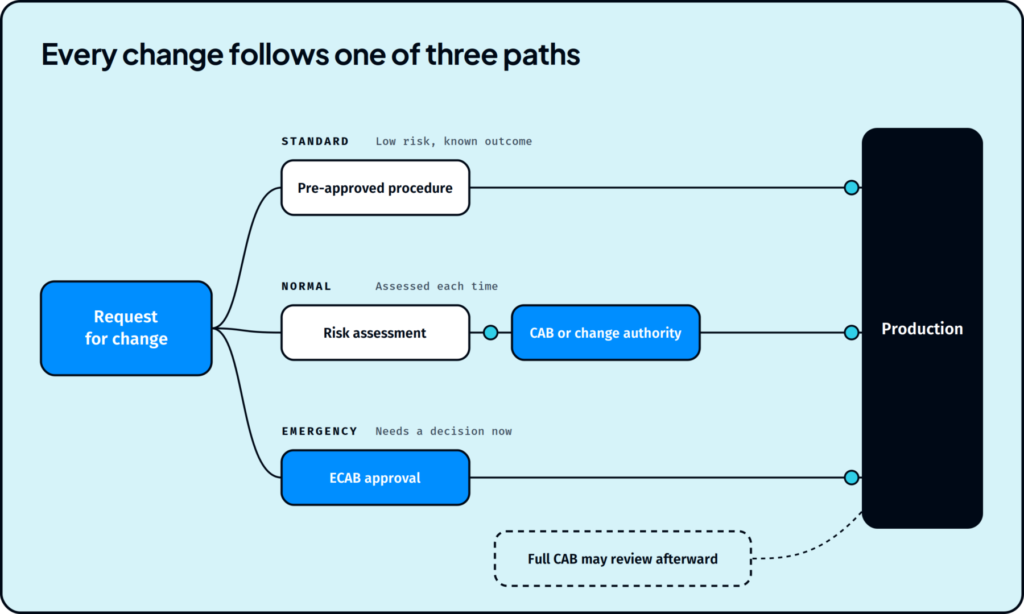
An emergency CAB (ECAB) is a smaller group that meets at short notice to approve urgent changes, such as a fix for a billing job failing on close night. It typically includes the change manager, the owner of the affected service and the specialists needed to judge the fix. The full CAB may review emergency changes at its next meeting.
What are the three ITIL change types?
ITIL change management defines three change types: standard, normal and emergency. Each follows a different approval path and needs a different level of review.
Change type
Risk
Approval route
SAP example
Standard
Low, with a known outcome
Pre-approved; follows a tested procedure
A recurring configuration transport of a type the board has already approved
Normal
Varies; assessed each time
Change authority, often with CAB advice
A support package stack, or a custom code change for a new interface
Emergency
High urgency
Expedited, often through an ECAB
A fix for a P1 that stops invoices posting
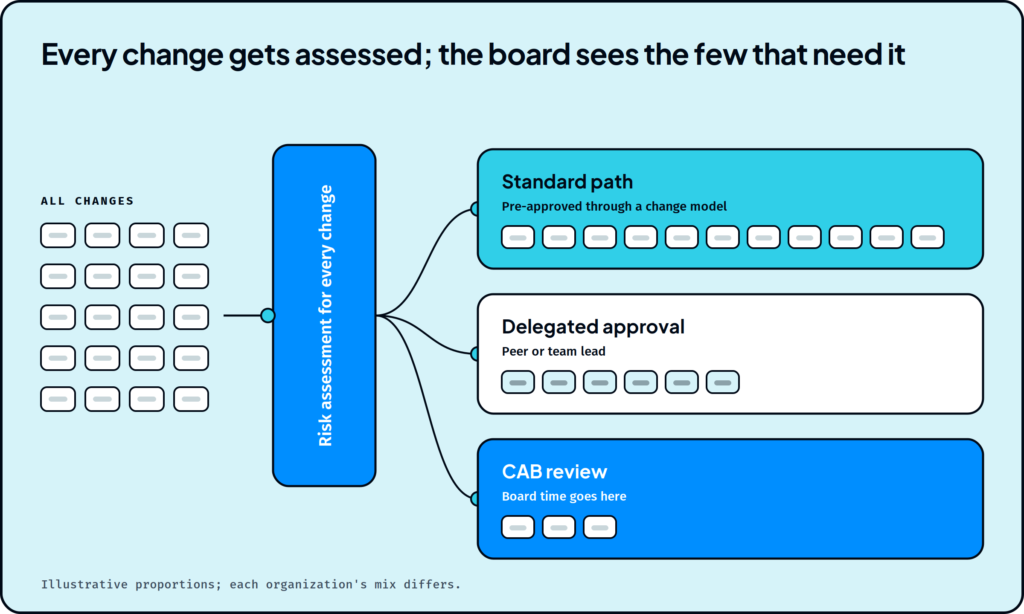
The standard path is the CAB’s best tool for handling volume. Change models can move proven, repeatable changes to the standard path, freeing board time for changes that carry more risk.
What happens in a CAB meeting?
A CAB meeting is the regular session where the board reviews requests for change and either approves them or makes its recommendation to the change authority.
Most run weekly, and a good agenda follows the same order every time:
- Recent changes: what was implemented since the last meeting, and which changes failed or caused incidents.
- New requests for change, sorted by risk, with the highest-risk changes first.
- Transport import schedule and sequencing: the Basis item, covering import order, predecessors and system windows.
- Conflicts and freeze periods, such as month-end close or a go-live weekend.
- Emergency changes approved by the ECAB since the last meeting, reviewed after the fact.
- Actions and owners.
The best CAB meetings are for decisions. When every change arrives with its briefing already sent, the board spends the session judging risk.
Why is rising change volume testing the CAB?
Many CABs were set up for a more predictable volume of change. Three forces are pushing more through them, and more of what arrives carries cross-system risk.
Migrations, upgrades and AI systems all arrive as changes
SAP’s mainstream maintenance for ECC and the other core Business Suite 7 applications ends at the end of 2027, with optional extended maintenance to the end of 2030. Migration transports and retrofits between ECC and S/4HANA now run alongside business-as-usual change.
The change-control tooling is moving too. SAP recommends completing the move from Solution Manager to SAP Cloud ALM before Solution Manager’s mainstream maintenance ends in 2027.
AI adds a third stream. DORA’s 2025 State of AI-assisted Software Development report finds that AI can improve throughput at the cost of stability when the foundations are weak. DORA’s 2024 research put a number on it: every 25% increase in AI adoption was associated with an estimated 7.2% drop in delivery stability, and the 2025 report found the negative relationship with stability persisted.
While that research covers software delivery broadly rather than SAP transports specifically, it’s still a strong reason to reassess change controls as AI systems connect to the estate.
Failures increasingly start where systems interact
Uptime Institute’s 2026 outage analysis, which covers data center and IT outages, predicts that failures will increasingly involve complex interactions between systems, including software, networks and external dependencies. Separately, its 2025 analysis found that IT and networking issues caused 23% of impactful outages in 2024, a rise Uptime links to change management and misconfiguration as complexity grows.
In SAP terms, that’s the transport that changes a pricing routine and also alters a field the warehouse interface reads. The change itself is sound. The risk sits in a dependency that nobody at the board was asked about.
DORA’s research questions heavyweight approval
DORA’s guidance on change approval, drawn from software delivery research, finds no evidence that a formal, external review process lowers change failure rates, and associates heavyweight approval with slower delivery.
DORA also notes that CABs are good at broadcasting change, while members far removed from a change may miss its implications. Its recommendation: peer review and automated checks close to the work for most changes, with the CAB in a more strategic role.
The CAB’s value is the risk judgment
DORA’s recommendation translates well to an SAP estate, applied with care for its software delivery origins. Delegate low-risk change to peer review or the standard path, reserve board time for changes that need business-level judgment, and improve the evidence the board receives. A useful test for your own CAB: how many changes did it review last quarter that a peer could have approved, and how many approved changes later caused an incident?
How can a CAB keep pace with more change?
To keep pace, a CAB needs to spend less time assembling evidence and more time judging risk.
Each CAB has five steps:
- Assess risk,
- Map dependencies,
- Prepare the briefing
- Decide the approval route
- Check the outcome after implementation
Agents can prepare the evidence. The board or delegated change authority keeps the decision.
The core challenge is ensuring AI agents can see how everything a change touches fits together.
Most failures happen between SAP and the systems around it, and migrations and upgrades alter integrations and dependencies, so one change can reach every process that depends on them.
A single transport can ripple across SAP, ServiceNow, Oracle and other enterprise systems, and through custom code, from classic ABAP to modern extensions built on SAP BTP or in languages like Java and Python. Full operational context gives an agent a view of how those systems and that code interact, and a risk score is only as reliable as that view.
Lightrun’s Change Risk Analyzer was built to give agents that view. Before every change, it analyzes transports and dependencies and produces a risk-scored CAB briefing, identifying risk, mapping dependencies and preparing the briefing in a single pass.
Agents identify the risk areas in every change
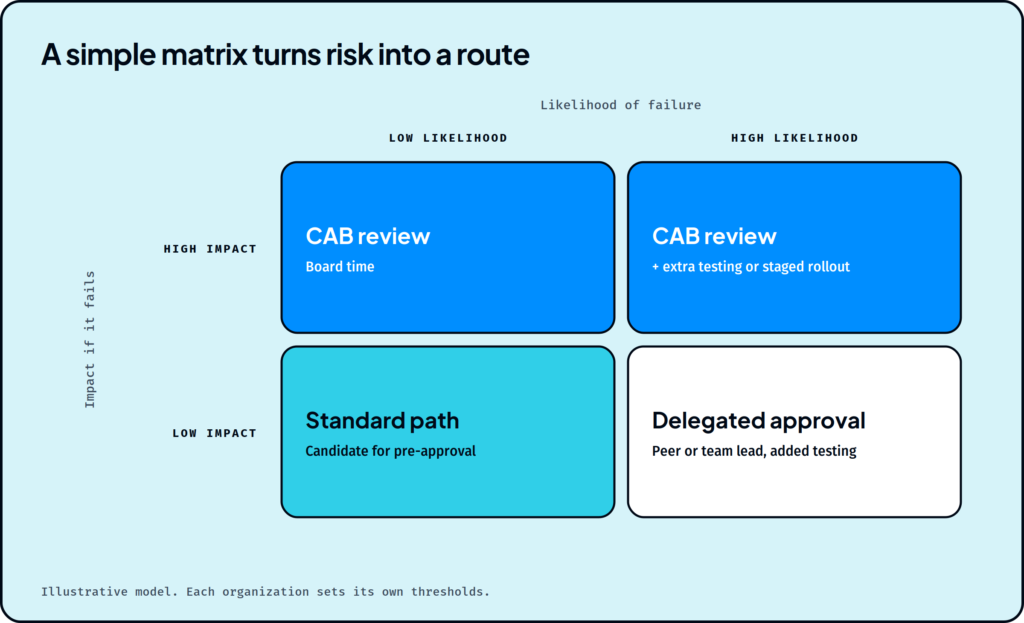
For every change, the Change Risk Analyzer identifies implementation, rollback and downtime risks, the core of a change management risk assessment. It weighs the impact of a failure, the likelihood of one, and what makes recovery easy or hard: dependencies, rollback options and test coverage.
Each change arrives with a score. The matrix below is an illustrative model for turning that score into an approval route; each organization sets its own thresholds.
Impact if it fails
Low likelihood of failure
High likelihood of failure
High impact
CAB review
CAB review, with extra testing or a staged rollout
Low impact
Candidate for the standard path
Delegated approval by a peer or team lead, with added testing
Agents map transport dependencies and affected systems
For SAP changes, the risk sits in everything a change touches. The Change Risk Analyzer maps changed objects, dependencies and affected systems, covering:
- Changed objects
- Predecessor transports and import order
- Affected systems and interfaces
- Rollback plan and downtime risk
- Test evidence
Agents prepare the briefing before the meeting
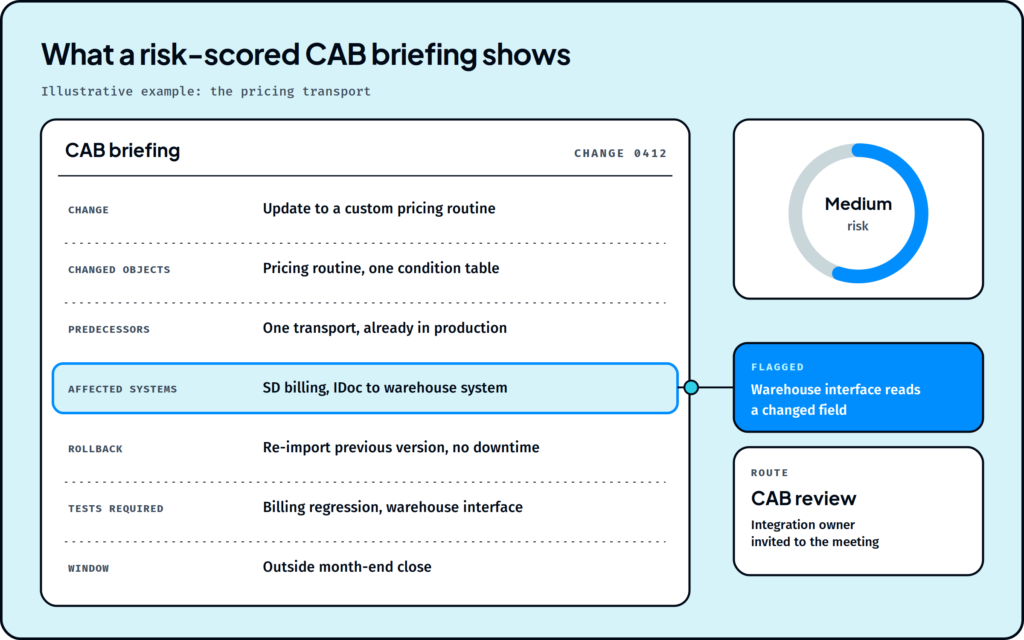
The agent then generates testing, approval and implementation checklists and assembles a risk-scored briefing that reaches the board before it meets. Illustrative example: what the briefing for the pricing change above contains.
Briefing field
Example
Change
Update to a custom pricing routine, transported to production
Changed objects
The pricing routine and one condition table
Predecessor transports
One, already imported to production
Affected systems
SD billing, and the outbound IDoc to the warehouse system
Risk
Medium impact, medium likelihood: CAB review
Rollback
Re-import the previous version of the routine; no downtime expected
Tests required
Billing regression and a warehouse interface test in QA
Recommended window
Outside month-end close
The briefing flags the warehouse interface before the board votes, so the integration owner can judge it in the room.
Routine changes move to the standard path
Change models and pre-approval move proven change types off the agenda. With every change scored, the pattern shows quickly: change types that consistently score low are candidates for the standard path. Review them every quarter.
Agents check every change after it lands
Post-implementation review closes the loop: did the change do what it promised, and did anything downstream break? When a change does cause an incident, Lightrun’s Incident Resolver classifies the ticket, traces the failure to root cause across logs, custom code, configuration and recent transports, and carries it through to an approved resolution. Those results feed the next risk score, so the assessment gets sharper with every cycle.
People keep every decision
Agentifying the process changes who prepares the evidence, and the board stays in charge. Both agents work read-only by default, every write action needs explicit approval, and every step is logged for audit. Lightrun’s Forward Deployed Engineers customize the agents to each landscape, including legacy systems and custom code.
| CAB task | Today | With AI agents |
|---|---|---|
| Risk assessment | Filled in by the requester, often from memory | Risk-scored briefing for every change |
| Dependency and transport mapping | Assembled by Basis from transport lists | Changed objects, dependencies and affected systems mapped |
| Rollback and downtime planning | Written per change, quality varies | Implementation, rollback and downtime risks identified |
| Checklists | Copied from templates | Testing, approval and implementation checklists generated |
| Post-change validation | Reviewed when something breaks | Incidents traced to root cause, including recent transports |
How do you measure CAB performance?
A healthy change process is both safe and timely, so measure the whole process alongside the board. DORA’s guidance points the same way, pairing approval delays with change failure rates. These measures show whether you’re keeping pace:
KPI
What it shows
Change failure rate
Share of changes that cause an incident or need a fix
Emergency change share
How much change bypasses normal review
Approval lead time
Time from request to decision
Routine changes on standard or delegated paths
How much change is decided close to the work
Incidents linked to recent changes
Whether risk reviews are catching what matters
Transports returned for rework
Quality of changes reaching the board
Definitions vary between organizations, so agree what counts as a failed change before you start tracking it: for example, whether a change that needs a follow-up fix but causes no incident counts as a failure.
Which of these does your CAB report on today? Change failure rate and approval lead time together tell you whether the board is both safe and fast.
What does a CAB built for today’s change volume look like?
The CABs that keep pace assess every change, route routine work to standard or delegated paths, and bring the board the decisions that need its judgment. Board time goes to real decisions, and Basis and AMS teams spend less time assembling evidence by hand.
See how the Change Risk Analyzer prepares every CAB briefing
FAQs
A change advisory board (CAB) is a group that reviews proposed changes to IT services and systems. It assesses risk, impact and timing, then advises the change authority or approves the change itself if it has that authority.
CAB approval means the board has authorized a proposed change, or recommended it to the designated change authority. Under ITIL 4, the change authority may be the CAB, a service owner, a peer reviewer or another delegated role.
A CAB typically includes the change manager as chair, owners of the affected applications and services, infrastructure and platform specialists, security, the service desk, and business owners of the processes the change touches. Membership flexes with what each change affects.
AI agents can prepare the evidence a CAB needs, such as a risk-scored briefing that maps each change’s objects, dependencies and affected systems, while the board keeps every decision. Safe setups run the agents read-only by default, require explicit approval for any write action, and keep a full audit trail.
Standard changes are low-risk, pre-approved changes that follow a defined procedure. Normal changes need a risk assessment and approval from a change authority, often with CAB advice. Emergency changes need to be implemented quickly and follow an expedited approval path, often through an ECAB.
An emergency change advisory board (ECAB) is a smaller group that reviews urgent changes, such as fixes for a major incident, that need approval before the next scheduled CAB meeting. It meets at short notice, and the full CAB may review the change afterward.