AI Agent Reliability Starts With Runtime Verification
Oct 09, 2026 / Updated: Oct 09, 2026


AI agent reliability depends on a check most reliability programs skip: whether the data an agent acts on still matches production at the moment it acts. An agent can pass every eval, respect every guardrail, and still restart healthy pods on a stale metric. This guide shows where that gap opens, why evals and guardrails miss it, and how runtime verification closes it.
Key Takeaways
- Most AI agent pilots stall before production: Forrester’s 2026 research found that 88% of AI agent pilots never reach production, with missing evaluation criteria and governance friction as the most cited blockers.
- Most reliability tooling scores agents against reconstructed data: Evals, regression suites, and trace-based scoring measure behavior on scenarios someone anticipated in advance.
- • Production visibility is the bottleneck for AI SREs: In Lightrun’s State of AI-Powered Engineering 2026 Report, 97% of engineering leaders report significant AI SREs operate without significant visibility into what’s happening at production.
- Small per-step error rates compound fast:
- A step that’s 95% reliable in isolation works out to roughly 60% reliable across a ten-step chain.
- The fix isn’t a better score; it’s a live check: The agent confirms its belief against the running service at the moment it acts, using live Runtime Context in place of historical logs and traces.
What Does “AI Agent Reliability” Really Mean?
AI agent reliability is an agent’s ability to produce correct outcomes across every step it takes, inside a production system that keeps changing. One good answer measures capability. Reliability measures whether the next hundred actions deserve the same trust.
Princeton researchers define it along four dimensions in Towards a Science of AI Agent Reliability:
- Consistency: the agent behaves the same way across repeated runs.
- Robustness: its behavior holds up under perturbations to inputs and conditions.
- Predictability: it fails in ways that can be anticipated and flagged.
- Safety: the severity of its errors stays bounded.
It’s about when an agent takes multiple consecutive actions, calls tools, reads live data, and makes decisions, it produces correct outcomes despite operating in a constantly changing system.
That distinction matters because most of what gets called “reliability work” today, evals, regression tests, observability dashboards really confirm that the agent will behave in theory, with an assumption that the same will hold true in practice.
If you’re newer to the underlying idea this post builds on, runtime context is worth a quick read first: it lays out why an agent’s live connection to production state, not just its training or its prompt, ends up being the thing that determines whether it can actually be trusted.
Here’s what this post covers: a real incident-response agent whose logic was correct, whose guardrails held, and that still caused real damage because nothing checked its belief against production. Then why that failure mode is structurally invisible to the eval-and-observability stack most reliability advice recommends today.
And finally, where that same pattern shows up across other common agent types, and what actually closes the gap.
When Correct Logic Still Fails: The 12-Pod Incident
An agent with correct logic and working guardrails can still cause an outage when its input data goes stale.
A platform team has an AutoRemediationAgent watching InventorySyncService.java. Its job is narrow and low-risk on paper: if the service’s connection pool looks exhausted, restart the pod, no human needed.
The agent cleared its pre-deployment eval suite convincingly:
- Task success above 90% across every simulated exhaustion scenario
- Zero flagged hallucinations
- Guardrails confirmed: one pod restart at a time, capped per hour, well within its approved blast radius.
The rule driving the restart decision is about as simple as agent logic gets:
| if connectionPoolActive == 0: restart_pod(service=”InventorySyncService”) |
If the exported metric connectionPoolActive reads 0, the pool is exhausted, the service is stuck, and the agent restarts the pod. In isolation, the logic is correct: a pool with zero active connections is stuck, and a restart clears it. The rule passes review, passes eval, and looks production-ready.
Here’s what the eval suite couldn’t see: a regression in the metrics exporter, shipped two hours earlier, froze connectionPoolActive at its last-reported value instead of updating it. The gauge hit 0 during a brief real spike, then stayed frozen at 0 for the next two hours and fourteen minutes. Behind it the pool recovered and settled at a healthy 40 of 50 connections in use.
The agent never saw that recovery. It only ever saw a metric that still read 0, exactly matching its rule. It acted on that belief twelve separate times over ninety minutes:
- Restarted 12 healthy pods
- Dropped in-flight inventory-sync jobs mid-transaction
- Triggered real customer-facing stockout errors in the US-EAST-1 region, once per restart
Nothing about this failure would have shown up in an eval run from the week before. The agent’s logic was sound given the data it had access to. The data itself had quietly stopped reflecting reality, and no amount of retraining, prompting, or offline scoring would have surfaced on its own, because the rule was never wrong. The belief it was being evaluated against was.
That’s the specific failure. It raises the real question: why does the standard reliability toolkit, evals, guardrails, observability, consistently miss this exact kind of failure, and not just in this one scenario?
Why AI Agent Evaluation Misses Runtime Failures
AI agent evaluation measures behavior against reconstructed data: traces of past runs, logs already written, and scenarios someone anticipated. Production failures like the frozen gauge happen in the live system, at the moment of action, which is outside every one of those inputs.
The standard reliability playbook follows a consistent formula:
- Define success metrics
- Build regression datasets
- Run simulated edge cases
- Instrument every span with OpenTelemetry
- Route production traces back into an LLM-as-judge scoring loop
Each step is useful work, and AI evals catch known failure modes early. Most playbooks close the loop after a failure: confirmed production incidents become new regression cases for the next eval run. Each step also scores the agent on data that was captured before the decision it’s being judged on.
Independent academic research points the same way. The February 2026 Princeton study on AI agent reliability found that improving accuracy alone doesn’t guarantee reliability gains on real-world tasks, and the gap isn’t vendor-specific: frontier models from every major provider cluster at a similar reliability plateau despite 18 months of steady capability gains.
The same paper catalogs real incidents where agents judged capable on internal evaluations still failed in deployment, including Replit’s AI coding assistant deleting an entire production database despite explicit instructions forbidding such changes. The pattern across these cases is consistent: an agent that scores well on a benchmark can still have a blind spot at the exact moment that matters most, the instant it’s deciding what to do next inside a live system.
Lightrun’s own data shows where the gap sits.. According to the State of AI-Powered Engineering 2026 Report, 44% of AI SREs or APM tool failures happen because the tools never captured the execution-level data needed to confirm what happened. The evidence was missing from the start, because nothing in the pipeline generated it on demand.
Why Reliability Degrades Across Multi-Step Agent Workflows
Per-step reliability compounds. A step that is 95% reliable sounds close to production-ready. Chain ten of those steps together, the kind of multi-tool, multi-service reasoning that a remediation agent, a code-review agent, or a support-triage agent actually performs, and the end-to-end success rate falls to roughly 60%.
To hold a ten-step workflow at 90% reliability, every step needs to clear 99%. Eval suites built on historical scenarios rarely test at that bar, because they can’t anticipate every schema change, upstream migration, or edge case a live system produces. Sierra’s τ-bench research measured the same effect in practice: agent consistency drops sharply as the same task repeats across trials.
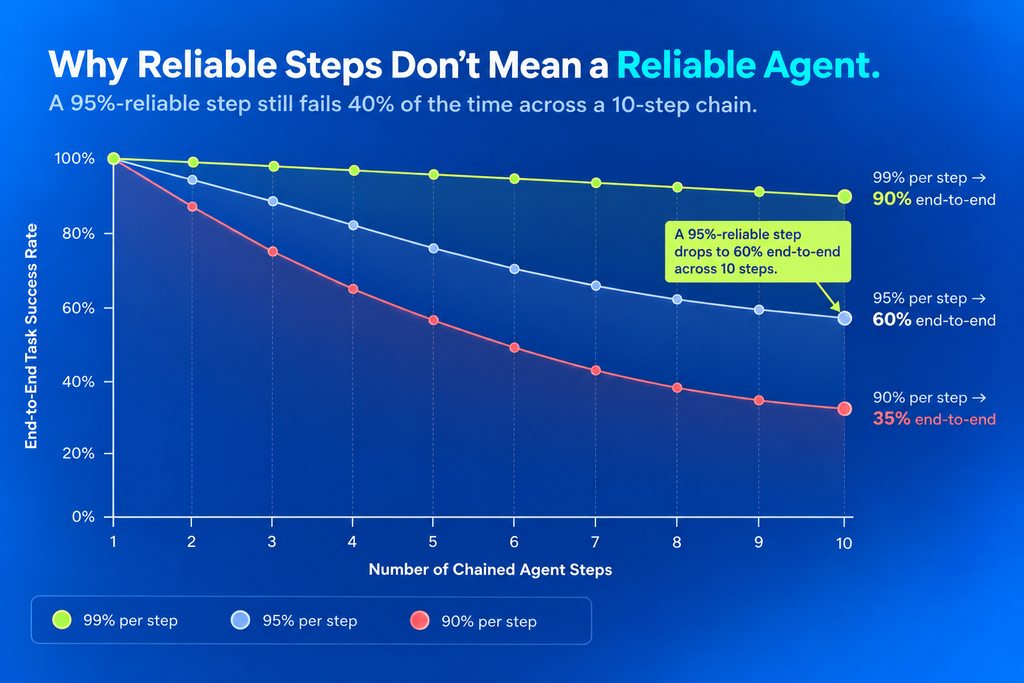
This is a big part of why so many agent pilots stall before full rollout: a March 2026 survey of 650 enterprise technology leaders found 78% had at least one AI agent pilot running, but only 14% had scaled one to organization-wide use.
A failing agent rarely crashes. It keeps taking actions that look correct for its inputs, the way a frozen connectionPoolActive: 0 looks like real exhaustion until someone notices twelve restarts with no deploy or traffic spike to explain them.
Why AI Agent Guardrails Didn’t Catch The Failure
A second common answer to agent reliability is guardrails: schema validation on outputs, permission boundaries on tool calls, rule-based gates that block obviously unsafe actions. Guardrails are necessary, but they solve a different problem than the one that broke the remediation agent.
A restart of a single pod, one at a time, with no more than a handful per hour, fell entirely inside the agent’s approved blast radius. The guardrail did exactly what it was built to do. What it could not do was confirm that the belief driving the action, that connectionPoolActive still reflected the pool’s current state, was actually true. The guardrail enforces the action boundary; it doesn’t verify whether the data feeding the agent’s reasoning matches the current production state.
So the pod-restart agent isn’t a one-off story. The same failure shape, correct logic, respected guardrails, a stale belief nobody checked, shows up across nearly every kind of production agent teams are shipping right now.
Where This Same Gap Shows Up Across Agent Types
Any agent that acts on cached, sampled, or exported data can follow correct logic and still produce the wrong outcome. The remediation agent is one instance. The same shape appears in four other agent types teams are shipping now: sound decision logic, guardrails that hold, and input data that has drifted from production.
Code Review and PR Approval Agents
An agent auto-approving pull requests checks a static analysis report, confirms test coverage thresholds, and validates that no flagged dependencies were introduced, all against a snapshot of the codebase and its dependency graph taken at CI time.
What breaks: A downstream service changes its API contract after that snapshot but before the merge window closes The agent approves a change that is correct against stale context and breaks in production the moment it ships.
The fix: Confirm the dependency’s current behavior in the running service at approval time.
Customer Support Triage Agents
A support agent routes a ticket to “billing” based on keyword matching and a customer’s subscription tier pulled from a cached CRM read.
What breaks: The customer upgraded to enterprise ten minutes ago, and the cache hasn’t refreshed. The agent routes an urgent enterprise ticket into the standard queue and misses an SLA it was never told to apply.
The fix: Read the customer’s current tier from the live system at routing time.
Deployment and Rollback Agents
A rollback agent watches error-rate dashboards and triggers an automatic revert if error rate crosses a threshold within five minutes of a deployment.
What breaks: The dashboard runs on a metrics pipeline with a two-minute ingestion lag. The agent reads a healthy error rate, declares the deploy safe, and closes its five-minute window while the real spike is still arriving.
The fix: Read the current error rate from the running service before closing the rollback window.
AI Coding Assistants Proposing Fixes
A coding agent asked to fix a NullPointerException reads the field’s type signature from the codebase, proposes a null check, and opens a PR.
What breaks: An upstream schema migration recently changed what the field holds at runtime. The fix compiles and passes review, and it patches the symptom while the real mismatch between the code’s assumption and the running service stays in place.
The fix: Capture the field’s live type and actual values from the running service before proposing the patch.
The pattern across all five agents: a sound rule, a guardrail that bounded the action correctly, and a strong eval score. Each one needed the same missing capability: a way to ask the live system, at the moment of decision, whether its belief still holds.
Which raises the obvious question: what would have actually caught this, in any of the five cases above?
What Closes the Gap: Runtime Verification at the Point of Decision
Runtime verification adds one step between an agent’s decision and its action: a live check of the belief behind the decision. The loop becomes:
Model decides → Runtime context verifies → Action executes.
The model stays probabilistic, proposing a hypothesis or an action the way it always has. The verification step checks that proposal against what the system is doing right now, at the specific line and moment the agent is about to act.
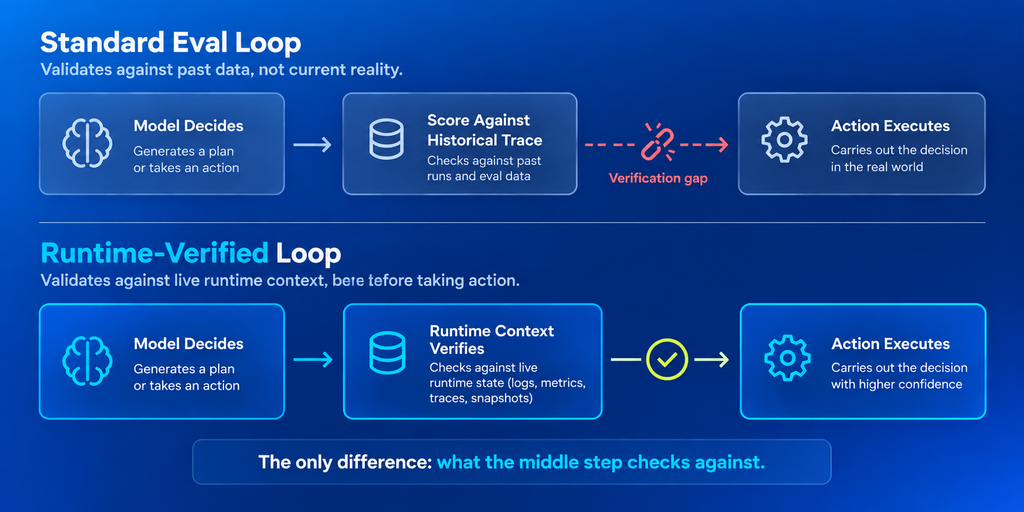
This is the gap Lightrun AI SRE agents are built to close. Tools that reason over pre-existing telemetry work from what was captured before the decision. Lightrun connects agent decision points to live execution state through Runtime Context, generating the exact evidence a decision needs, on demand, with no redeployment.
It’s also the specific capability engineering leaders say they need most: when Lightrun’s State of AI-Powered Engineering 2026 Report asked what it would actually take to trust an AI SRE’s fix, the top answer, chosen by 58% of respondents, was the ability to generate evidence traces of variables at the point of failure, ahead of every other capability offered.
Applied back to the four use cases above, the same verification step changes each outcome:
| Agent Type | What It Verifies Live, Before Acting |
| Remediation agent | The actual current connection pool state, not the exported gauge value |
| Code review / PR agent | The dependency’s live current behavior, not its behavior at CI snapshot time |
| Support triage agent | The customer’s current subscription tier from the live system, not a cached CRM read |
| Rollback agent | The current error rate from the running service, not a metrics pipeline with ingestion lag |
| Coding assistant | The live type signature and usage of the field it’s patching, not the type as last documented |
The Pod-Restart Agent: Runtime Verification in Action
Applied to the remediation agent scenario specifically, this changes the failure mode entirely.
Before restarting a pod, the agent’s decision gate queries the actual, current connection pool state directly inside InventorySyncService.java, rather than trusting the exported gauge value it was handed. The moment that live query returns 40 of 50 connections active while the metric still reads 0, the discrepancy itself becomes the finding: not a pool exhaustion, but a frozen exporter. The agent gets a specific answer instead of a stale number, and the restart never fires.
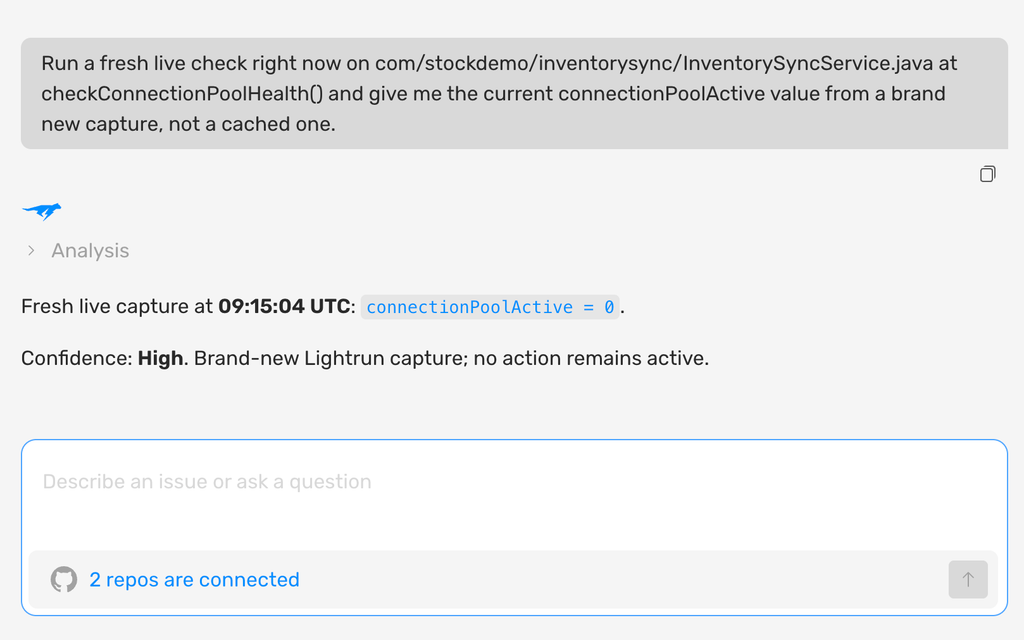
As you can see in the screenshot above
- The live connection count is captured directly from the running service, next to the value the exporter reported.
- The gap between the two identifies a metrics exporter regression, and the restart never fires.
Validating the Corrected Rule Before It Ships
The same check validates the fix. Before the corrected rule ships, a developer evaluates its condition against live values from the running service and confirms it suppresses the restart.
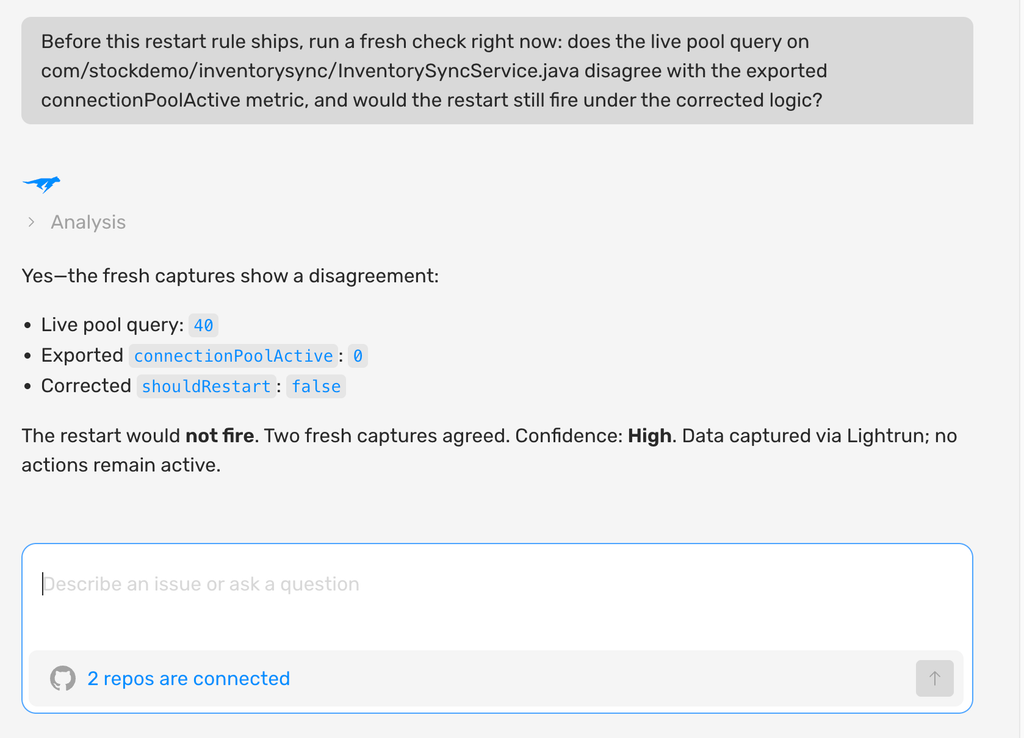
As you can see in the screenshot above:
- The live pool count returns 40 while the exported metric still reads 0, reproducing the exact conditions of the incident.
- shouldRestart resolves to false under the corrected logic across two independent captures, so the fix is proven before it reaches production.
How Runtime Verification Improves AI Agent Reliability
Runtime verification improves AI agent reliability by checking each consequential decision against live production state at the moment it’s made. Each gap covered above maps to a specific fix:
| Reliability Gap | How Runtime Verification Resolves It |
| Stale assumptions in agent reasoning | Every consequential decision queries live execution state at the moment of the decision, not a cached trace |
| Silent failures that pass eval suites | Runtime evidence surfaces the discrepancy at the exact line and moment it occurs, rather than after aggregate symptoms accumulate |
| Guardrails that bound action but not belief | Verification checks the underlying data the agent is reasoning from, closing the gap guardrails were never designed to cover |
| Compounding multi-step failure | Each step in a chain can be verified independently against production state, preventing one stale assumption from propagating downstream |
| Build-time blind spots | Runtime context delivered through MCP lets coding agents validate assumptions before a change ships, not only after it breaks |
Reliability Is Only as Strong as the Verification Behind It
A remediation agent restarted 12 healthy pods. Four other common agent types fail the same way, and the same missing step fixes all five.
Much of what passes for AI agent reliability engineering today is agent evaluation engineering, and evaluation and reliability are two distinct disciplines.
Eval suites, regression datasets, and trace-based scoring answer whether an agent behaved correctly on the scenarios someone thought to test. They cannot answer whether its belief about the system it is acting on right now still matches reality, which is the question that actually determines whether a remediation agent, a customer-facing agent, or a coding agent stays trustworthy in production.
- Guardrails define what is allowed to do.
- Observability records what an agent already did.
- Runtime verification confirms what an agent believes, before it acts.
As agents take on more decisions that used to need a human in the loop, reliability moves from a property measured after the fact to a property verified at the moment it matters. Grounding agent decisions in runtime context makes that shift possible, so agents prevent failures as well as resolve them.
.
FAQ
What is AI agent reliability?
AI agent reliability refers to how consistently an autonomous AI agent produces correct outcomes when taking multi-step actions in a live production environment, rather than the accuracy of a single model response. Because agents chain tool calls, decisions, and state changes, reliability depends not just on the underlying model but on whether each step in that chain can verify its assumptions against the system it operates on.
Why do AI agents fail in production even after passing evaluation?
AI agents typically fail in production because eval suites and regression tests are built on historical scenarios and reconstructed traces, which cannot anticipate every schema change, upstream migration, or edge case a live system will eventually produce. An agent can reason correctly given the data it has access to while that underlying data has quietly drifted from what production is actually doing, producing failures that no offline evaluation would have caught.
What is the difference between an eval and runtime verification?
An eval scores an agent’s behavior against a fixed dataset or historical trace to measure how it performed on scenarios someone already anticipated, while runtime verification checks an agent’s live assumption against the system’s actual state just before it acts. Evals are essential for catching known failure modes before deployment, but only runtime verification can catch the failures that stem from production state changing in ways no eval dataset predicted.
Do guardrails make AI agents reliable?
Guardrails constrain what actions an agent can take, such as blocking a tool call outside an approved boundary, but they do not verify whether the data feeding the agent’s reasoning is accurate. An agent can stay entirely within its guardrails and still make an incorrect decision if the runtime state it believes to be true no longer matches what the system is actually doing.
How is runtime context different from traditional AI observability for agents?
Traditional observability for AI agents relies on pre-captured logs, metrics, and traces that describe what a system was doing at some point in the past, requiring teams to infer current behavior from historical signals. Runtime context instead generates live execution evidence, variable values, execution paths, and system state on demand at the exact moment an agent needs to verify an assumption, closing the gap between what telemetry shows and what the system is actually doing right now.