Why AI Agent Orchestration Needs Runtime Context Between Agents
Aug 21, 2026 / Updated: Aug 20, 2026


Every multi-agent system depends on one agent handing its output to the next, and nothing in the architecture confirms that the handoff carried what it should have. Orchestration adds a failure surface that single-agent architecture doesn’t have: a point between every two agents where one has to trust that the other passed along everything it needed, unverified.
Key Takeaways
- Orchestration adds a new failure surface that single-agent architecture doesn’t have. Every handoff between agents is a point at which one agent must trust that the previous one passed along everything it needed. In most orchestration designs, nothing verifies that assumption.
- On average, 44% of AI SRE or APM investigations fail because the execution-level data needed to complete them was never captured (Lightrun’s 2026 State of AI-Powered Engineering Report). In an orchestrated system, that same gap appears one level up, where the evidence a receiving agent needs was dropped before it arrived.
- 77% of engineering leaders have low or no confidence that their current observability stack provides enough information for reliable, automated root cause identification.
- The failure mode is rarely a broken handoff. A message between two agents can be well-formed, on time, and successfully received, and still miss the one detail the receiving agent needed to reason correctly.
- Tracing shows that agents talked to each other. It doesn’t show what they actually said. Runtime context closes that gap by making the content of a specific handoff inspectable.
What AI Agent Orchestration Actually Means
AI agent orchestration is the layer that coordinates multiple agents toward a shared goal: deciding which agent runs next, what each one receives from the others, and how their individual outputs combine into a final result. Where a single agent’s architecture is about perceiving, reasoning, and acting in one loop, orchestration is about managing several of those loops at once, each running as a distinct agent with its own scope.
Orchestration is not just a case of running multiple agents simultaneously; it adds handoffs, and each is a new risk area for something to go wrong. In practice, this shows up across several kinds of enterprise systems:
- An incident-response system in which one agent gathers logs, a second correlates recent deployments, and a third drafts a postmortem based on what the first two found.
- A procurement approval system where one agent extracts contract terms, a second checks them against policy, and a third routes the result to the right approver.
- A customer research pipeline where one agent pulls support tickets, a second summarizes sentiment by theme, and a third drafts a product brief from the summary.
In every case, the individual agents can each reason correctly from what they were given, and the system can still reach the wrong conclusion because the data it uses is incomplete.
Single-Agent vs. Multi-Agent: Why Orchestration Exists
Teams move from a single agent to an orchestrated multi-agent system for a specific reason: a single agent trying to hold an entire complex task in one reasoning loop has to carry all the context, all the tools, and all the decision logic at once, which strains both its context window and the reliability of any one reasoning pass.
Splitting the task across specialized agents, one focused on gathering data, another on analysis, a third on producing the final output, keeps each individual agent’s job narrow and its reasoning more reliable.
The trade-off is that reliability moves from being a single-agent problem to a coordination problem. A single agent’s memory layer either has the full context or it does not. A multi-agent system’s coordination layer decides what gets passed from one agent to the next, and that decision is a second place, beyond any one agent’s reasoning, where information can be lost.
Common Agent Orchestration Patterns
Most production orchestration systems follow one of a few coordination structures, and the choice affects where handoff failures are most likely to happen.
- Orchestrator-led: a central orchestrator agent calls each sub-agent in sequence or in parallel, collects their outputs, and decides what to pass forward.
- This is the pattern Anthropic’s own research on building effective agents describes as the “orchestrator-workers” pattern, and it concentrates the handoff risk in the orchestrator’s summarization and routing logic.
- Peer-to-peer: agents pass context directly to one another without a central coordinator, useful for tightly coupled tasks but harder to audit, since there is no single point where the full picture is assembled.
- Hierarchical: a lead agent delegates to sub-agents that can themselves delegate further, common in complex research or engineering workflows, where context has to survive multiple layers of delegation before it reaches the agent that actually needs it.
The pattern determines where the risk concentrates. An orchestrator-led system most often loses context during the orchestrator’s own summarization step. A peer-to-peer system loses it in whichever agent decided a detail wasn’t relevant to pass along.
Why Every Handoff Risks Lost Engineering Context
A single-agent architecture has only one memory layer to worry about. An orchestrated system has one for every agent, plus the handoff logic connecting them, and none of those handoffs are verified by default.
- The sending agent assumes its output is complete for whatever the next agent needs, even though it doesn’t know how the next agent will actually use it.
- The orchestrator assumes its summarization preserved what mattered, even though summarization is itself a reasoning step that can deem a critical detail safe to condense away.
- The receiving agent assumes what it received is the full picture and has no way to know that a detail was dropped one step earlier.
Distributed tracing, the standard tool for understanding what happened across multiple services, confirms that a handoff occurred and roughly when. It was built to answer “did service A call service B,” the same category of question OpenTelemetry’s own observability model is designed around.
It was not built to answer “did the payload B received still contain what A actually found,” which is exactly the question that matters when the sender and receiver are both reasoning models making judgment calls about what’s worth keeping.
How an Incident-Response Orchestration Can Silently Miss a Root Cause
Take an incident-response orchestration triggered by a latency alert on checkout-service. An orchestrator agent, implemented in IncidentOrchestrator.py, coordinates three sub-agents:
- LogGathererAgent pulls the last 30 minutes of logs and traces for the affected service.
- DeployCorrelatorAgent checks recent deployments and config changes against the incident window.
- PostmortemAgent synthesizes a draft postmortem from what the first two agents found.
LogGathererAgent did its job correctly, pulling 47 relevant log lines, including one reading ERR_CONN_POOL_EXHAUSTED at 09:14:02. The orchestrator’s handoff logic, a method called summarizeForHandoff(), condenses the raw log output into a shorter summary before passing it to DeployCorrelatorAgent, since passing all 47 raw lines to every downstream agent would blow through each agent’s own context budget.
The summarization step, itself an LLM call, condensed the 47 lines into three bullet points and judged the specific ERR_CONN_POOL_EXHAUSTED error code as redundant, replacing it with a more general bullet point reading “elevated error rate observed.” The exact error code and the 09:14:02 timestamp tied to it never reached DeployCorrelatorAgent.
Without that specific detail, DeployCorrelatorAgent correlated the incident with the closest deployment it could find in its own data: a feature flag change from three days earlier, instead of the database connection pool configuration change that had actually shipped that same morning at 09:10. PostmortemAgent, reasoning correctly over what DeployCorrelatorAgent gave it, produced a coherent, well-written postmortem naming the wrong root cause.
Every individual step in this pipeline succeeded:
- LogGathererAgent’s log pull succeeded and returned real data.
- The summarization call succeeded and returned a well-formed summary.
- DeployCorrelatorAgent’s correlation succeeded and returned a plausible, wrong answer.
- PostmortemAgent’s synthesis succeeded, producing a clean, readable document.
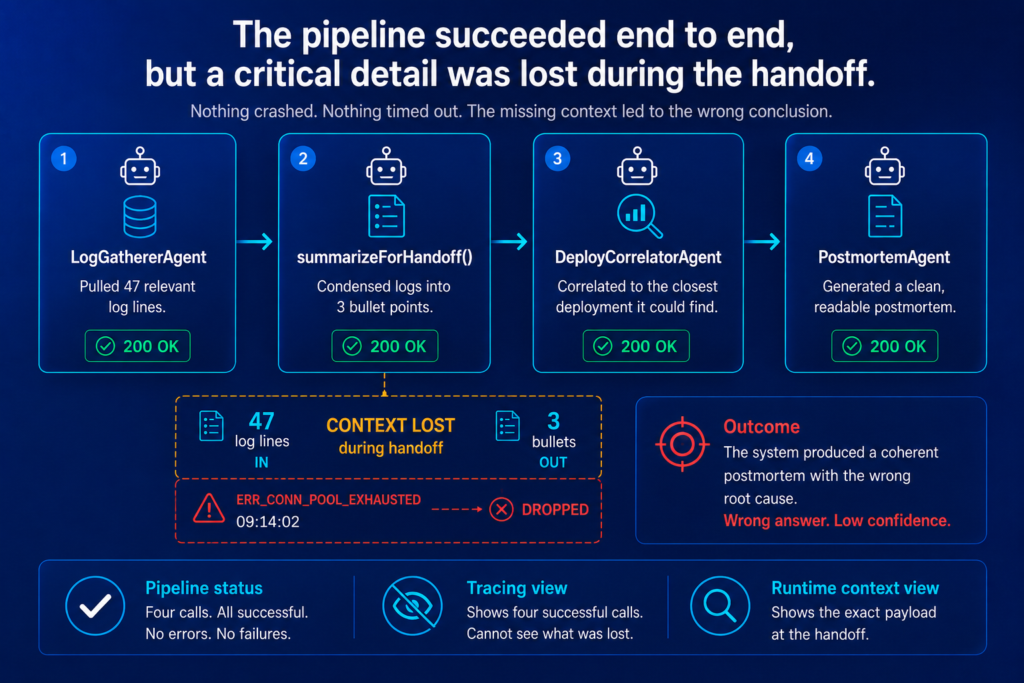
Nothing crashed, and nothing looked wrong from the outside. This is the same shape of failure covered in Lightrun’s agentic workflow blog, where a workflow succeeds end-to-end yet produces the wrong result, except that here the missing detail was lost not within one agent’s memory but during the handoff between two agents.
Why Multi-Agent Tracing Isn’t the Same as Runtime Context
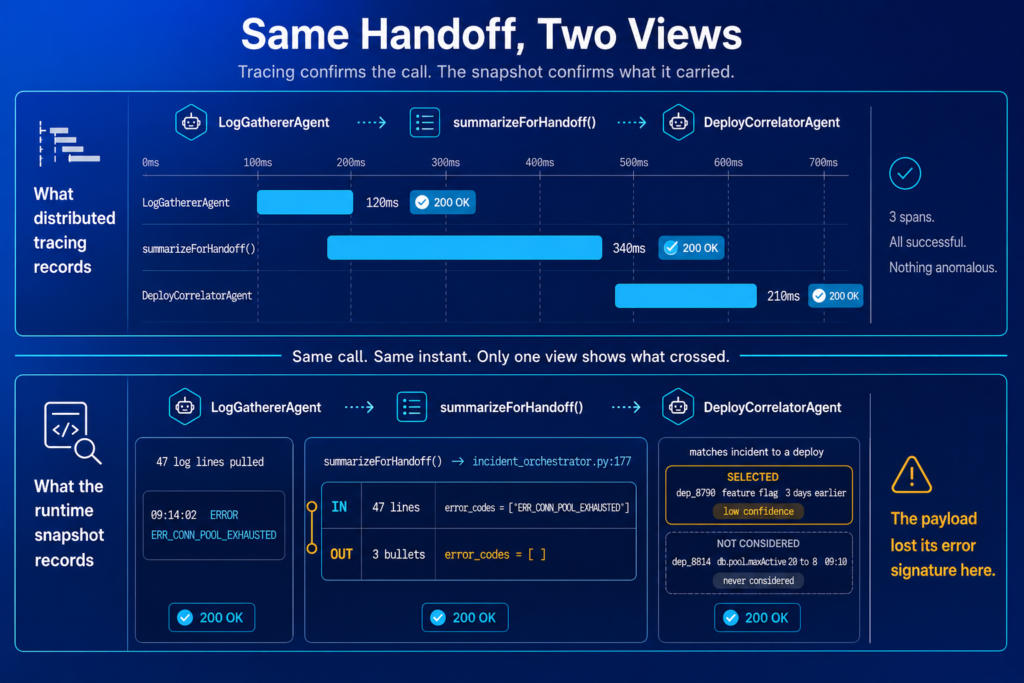
Standard multi-agent tracing tools, and most observability platforms built for agent pipelines, log which agent called which, how long each step took, and whether each call succeeded.
That data would have shown, in the incident above, that LogGathererAgent, summarizeForHandoff(), and DeployCorrelatorAgent all ran successfully, in order, on time. None of it would have shown that ERR_CONN_POOL_EXHAUSTED was in the input to the summarization step and absent from its output.
This is the same confirmation gap covered in the context of a single agent’s memory layer, one level up. The question isn’t whether a handoff happened, tracing already answers that well.
The question is whether the specific content of that handoff, on this specific run, still contained what the next agent needed to reason correctly, and that requires inspecting the actual payload at the actual moment it crossed the boundary between two agents, not just confirming the boundary was crossed.
Designing Orchestration Around Runtime Context
Closing this gap means applying the same principle to single-agent architecture: runtime context has to be a layer of the orchestration design itself, applied at every handoff, not just within each agent.
- At the handoff point, the Lightrun Runtime Sensor can inspect the exact payload a summarization or routing step produced before it reaches the next agent, so an engineer can confirm what actually crossed the boundary rather than inferring it from the next agent’s behavior.
- During root cause investigation, the same runtime context lets an engineer trace a wrong final output backward through each handoff to the exact step where a specific detail was dropped, rather than re-running the whole pipeline and hoping the failure repeats.
- For live incidents, Lightrun AI SRE applies this at the point where an orchestration is actively running, generating the evidence needed to confirm which agent and which handoff produced the wrong input for the next step.
This is also where multi-agent design connects back to single-agent architecture: the same runtime context principle covered in why internal agents must be rebuilt with runtime context applies whether the gap is within one agent’s memory layer or between two agents’ handoffs.
Lightrun Hands-On: What the Handoff Actually Carried
An orchestrator-led incident response was triggered by a latency alert for checkout-service, and the postmortem it produced identified a feature flag from three days earlier as the root cause. The real cause was a change to the connection pool config: db.pool.maxActive reduced from 20 to 8, deployed at 09:10 that same morning.
Every agent in the pipeline succeeded, every call returned HTTP 200, and the orchestration exited cleanly, so nothing in the trace explains how the conclusion went wrong.
Engineers using Lightrun MCP can interrogate live runtime behavior directly from their AI coding assistant, without adding a single log statement or redeploying the orchestration.
The suspicion here is that summarizeForHandoff() dropped the connection pool error while condensing the log output, so the engineer places a conditional snapshot on the handoff line and asks one question in plain language: did ERR_CONN_POOL_EXHAUSTED survive the handoff to DeployCorrelatorAgent?
The condition matters as much as the location. Setting len(dropped_codes) > 0 means the snapshot fires only on runs where something was genuinely lost, so a hit is itself the finding rather than a pile of data to sift through.
As you can see in the screenshot above:
- The engineer asks one question in natural language, and Lightrun MCP places the snapshot, waits for the condition to fire, and returns the captured values without any manual instrumentation.
- The answer is unambiguous: inbound_error_codes contains ERR_CONN_POOL_EXHAUSTED while outbound_error_codes is empty, so the error code entered summarizeForHandoff() and did not leave it.
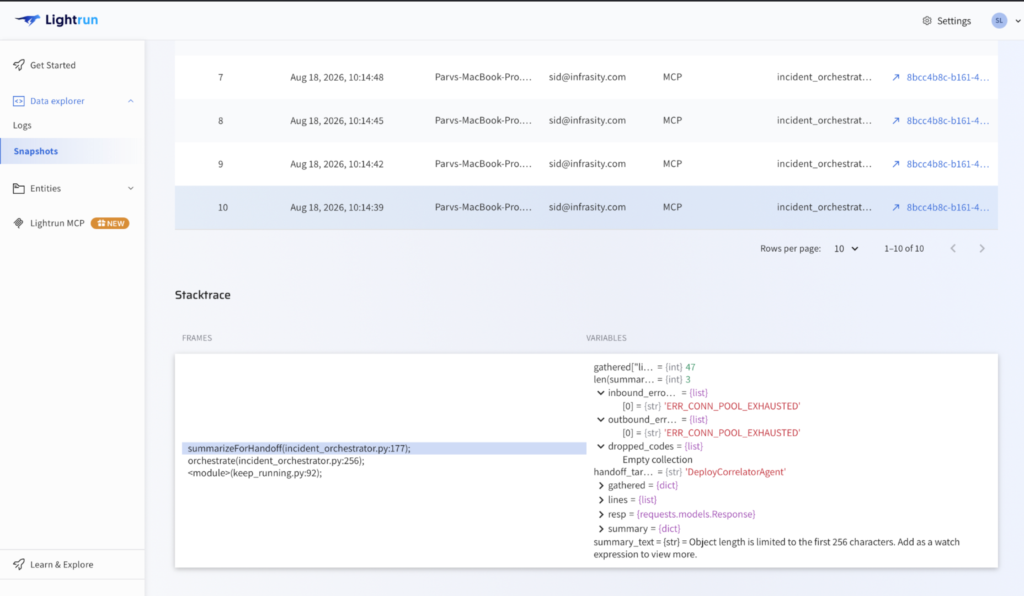
The same capture is available in the Lightrun platform, where the snapshot is stored alongside the stacktrace that produced it.
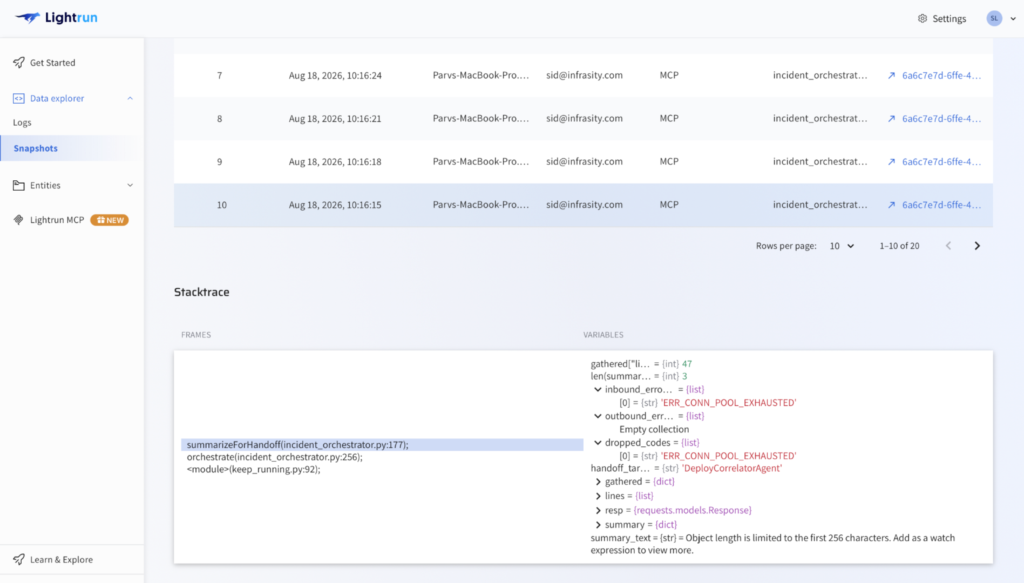
As you can see in the screenshot above:
- The stacktrace locates the capture inside summarizeForHandoff() called from orchestrate(), which places the loss in the orchestrator’s own handoff logic rather than in either agent’s reasoning.
- The variables panel shows 47 log lines going in and a three-bullet summary coming out, with dropped_codes holding the exact error code that went missing, captured at the moment the payload crossed the boundary.
Standard tracing for this same handoff reports a successful call returning a well-formed summary, with no way to establish that the summary was missing the one detail DeployCorrelatorAgent needed to correlate against the right deploy.
Without that error code, DeployCorrelatorAgent had only a generic signal of elevated error rates to work from, so it matched the incident to the nearest change it could find and reported low confidence.
The fix is not to push all 47 raw lines through every handoff, since that reintroduces the context budget problem that the summarization was built to solve, but to ensure the step preserves structured fields such as error codes and timestamps alongside the prose rather than treating them as text to be condensed.
Rerunning the same incident with the updated handoff logic, the engineer asks the same question again and confirms the change under the exact conditions that produced the original miscorrelation, rather than waiting for the next real incident to find out.
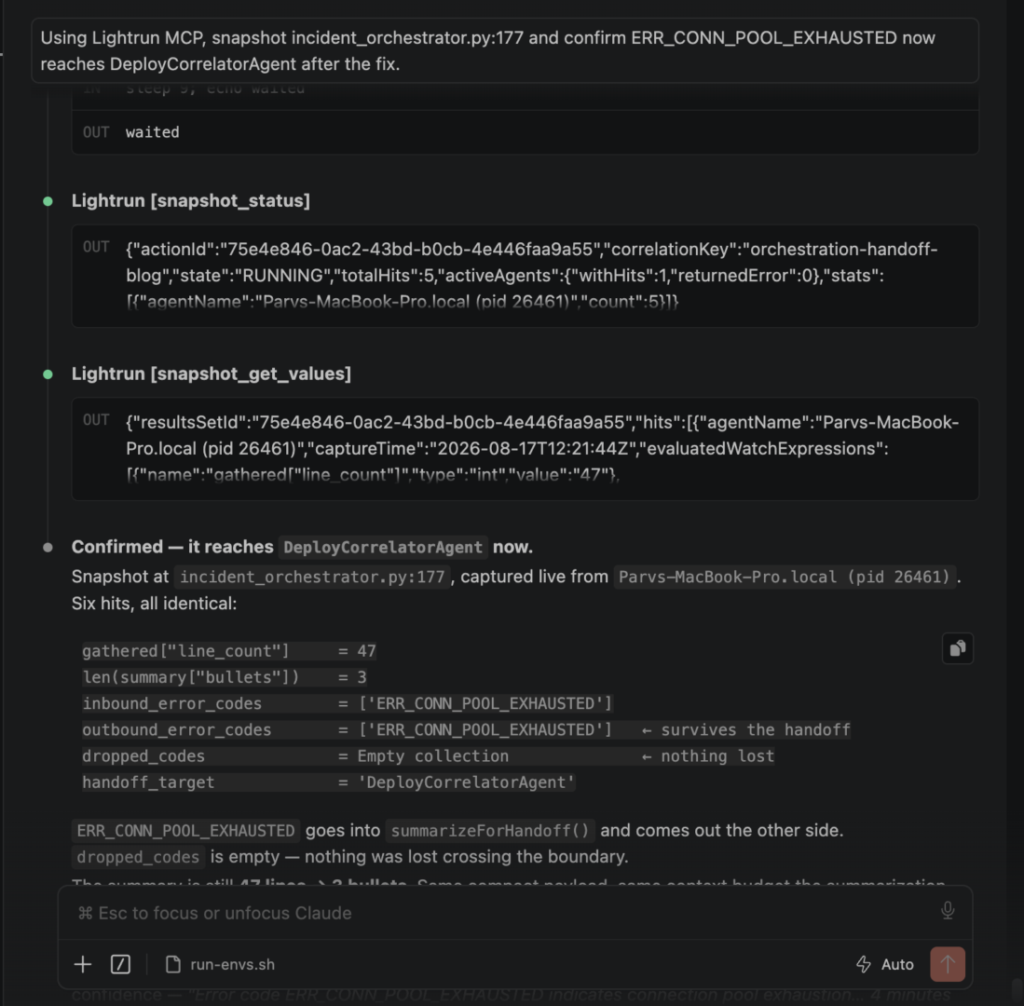
As you can see in the screenshot above:
- The same question, using the updated logic, returns the opposite answer: outbound_error_codes now contains ERR_CONN_POOL_EXHAUSTED, and dropped_codes is empty.
- The verification takes one prompt against the running orchestration, so the fix is confirmed before it ships rather than after the next incident tests it.
The platform view confirms the same result at the same line, against the same handoff.
As you can see in the screenshot above:
- The updated handoff still produces a compact three-bullet summary from the same 47 lines, so the context budget that justified the summarization is unchanged, but outbound_error_codes now carries the error code through to the receiving agent.
- With the error code and its 09:14:02 timestamp preserved as structured fields, DeployCorrelatorAgent correlates the incident with the connection pool config change deployed at 09:10 and reports high confidence, replacing a coherent wrong answer with a verifiable correct one.
Traditional Orchestration vs. Runtime-Aware Orchestration
| Handoff Concern | Traditional Design | Runtime-Aware Design |
| Handoff visibility | Confirms a call happened and succeeded | Confirms the exact payload content at the moment it crossed the boundary |
| Summarization steps | Treated as a black box between agents | Inspectable, so dropped fields can be confirmed directly |
| Root cause tracing | Re-run the pipeline and hope the failure recurs | Trace backward through each handoff to the exact drop point |
| Fix validation | Ship and wait for the next real incident | Replay the same incident conditions against the updated logic |
Coordination Is Only as Reliable as What Survives the Handoff
Teams designing multi-agent orchestration tend to focus on which agent does what, since that division of labor is what enables the system to handle a complex task at all. As a result, it’s easy to assume that once each agent reasons well, the system is reliable.
The incident-response example shows why that assumption doesn’t hold: every agent reasoned correctly, and the system still reached the wrong conclusion, because the constraint was never any single agent’s reasoning quality.
The constraint lies in the handoff itself: whether summarization and routing preserved what the next agent needed. No amount of improving one agent’s reasoning fixes a detail that was already dropped before it saw the input. This is a coordination problem, not a model problem.
As orchestrated systems take on more judgment calls in incident response, compliance, and customer-facing decisions, confirming what crossed each handoff matters as much as confirming each agent’s output. Runtime context applied at the handoff is what turns “the pipeline ran successfully” into a claim that can actually be checked.
FAQs
AI agent orchestration is the layer that coordinates multiple AI agents toward a shared goal, deciding which agent runs next, what each one receives from the others, and how their outputs combine into a final result. It differs from single-agent architecture in that reliability depends not just on each agent’s own reasoning, but on what survives the handoffs between them.
AI agent orchestration typically follows one of three patterns: orchestrator-led, where a central agent calls sub-agents and combines their outputs; peer-to-peer, where agents pass context directly to one another without a coordinator; and hierarchical, where a lead agent delegates to sub-agents, who can delegate further. Each pattern concentrates handoff risk in a different place: the orchestrator’s summarization logic, the sending agent’s judgment, or the depth of delegation.
Each agent in the pipeline can reason correctly over the input it receives, but that input depends on what the previous agent or the orchestrator’s handoff logic chose to pass along. A summarization step that condenses a detailed log into a short summary can deem a specific error code safe to omit, and the next agent has no way to know that something was dropped before it ever saw the data.
A single agent has a single memory layer, where context can be lost. An orchestrated system has one memory layer per agent, plus the handoff logic connecting them, which means there are more places for a critical detail to be dropped and no single layer responsible for catching it. Reliability in orchestration depends on verifying handoffs specifically, not just each agent’s internal reasoning.
Distributed tracing confirms that a handoff between agents happened, how long it took, and whether the call succeeded, which is useful but incomplete. It does not confirm whether the actual payload that crossed the handoff still contained the specific detail the receiving agent needed, since a call can succeed and return a well-formed but incomplete summary.