Three S/4HANA Migration Disasters and How Not to Be Next
Nov 23, 2026 / Updated: Nov 23, 2026

With SAP ECC 6.0 mainstream maintenance ending in 2027, every company running on SAP has to run the gauntlet of migrating to S/4HANA. The payoff is a modern, longer-supported platform with faster access to business data and simpler processes. But the move comes with a major risk in cutover: you’re moving core systems while the business keeps running, so when something goes wrong, revenue, fulfillment, and financial close can stall at once. This isn’t hypothetical, Haribo, SPAR, Lamb Weston, and Zimmer Biomet have all felt the impact, and the cost ran to hundreds of millions of dollars.
Key Takeaways
- S/4HANA go-live failures have severe financial impact. Cutovers at SPAR Group, Lamb Weston, and Zimmer Biomet led to major inventory write-offs, lost sales reaching hundreds of millions of dollars, damaged share prices, and lawsuits.
- Cutover failures often surface where SAP meets warehouse and logistics execution. At SPAR, Lamb Weston, and Zimmer Biomet, order picking, distribution-center inventory, and warehouse management were among the hardest-hit operations.
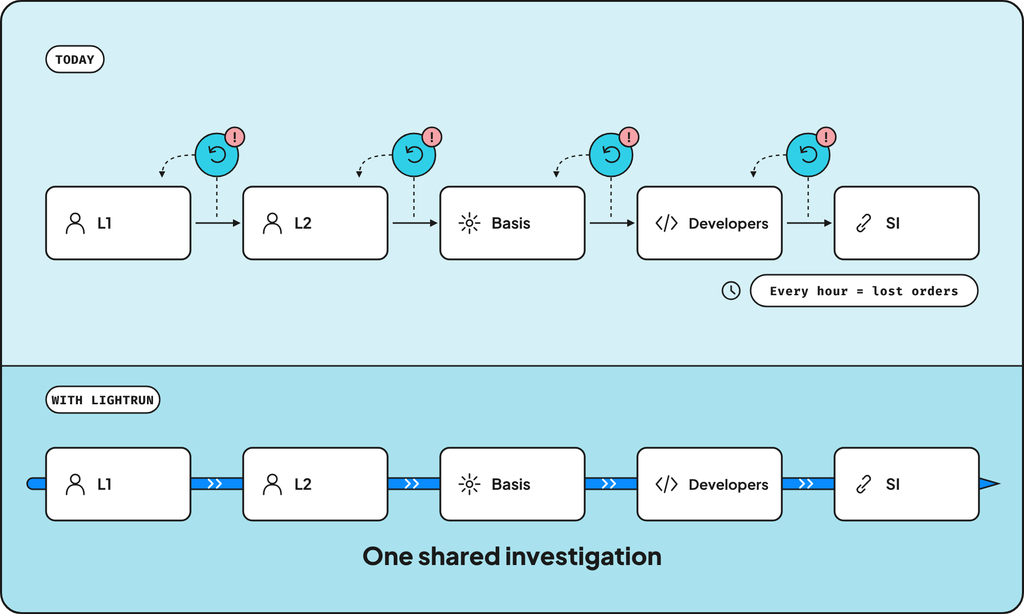
- Successful hypercare needs one shared investigation across support teams. When a ticket passes from L1 to L2, Basis, developers, and the SI, each handoff restarts the investigation, and every hour means lost orders.
- Agents grounded in operational context keep critical processes running. Lightrun’s Transformation agents and Reliability agents ground clean core decisions, change approvals, and incident resolution in how your landscape runs today.
Three S/4HANA Go-Lives That Went Wrong
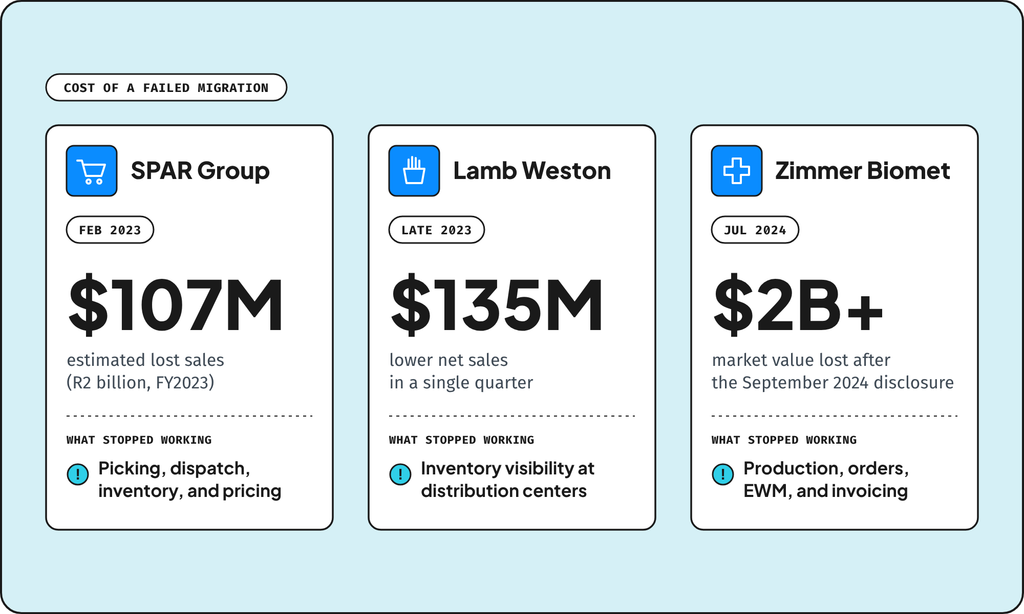
The three cases below involve publicly traded companies, including two Fortune 500s, in grocery retail, food manufacturing, and medical devices. Each entered cutover with a plan and careful sign-off. At go-live, critical processes such as order fulfillment, production, and invoicing stalled. The costs ranged from $135 million in lost quarterly sales to a 19% one-day stock drop, a franchisee lawsuit, and a suit against an SI.
SPAR Group: The Migration That Cost $107 Million in Lost Sales
SPAR is an international supermarket franchise with 2,556 stores in South Africa. In February 2023, the company moved its KwaZulu-Natal distribution center onto SAP S/4HANA, cutting over warehouse management, finance, and purchasing in one migration.
According to a franchisee’s court papers, go-live caused “an immediate breakdown in order picking, dispatch scheduling, inventory visibility and pricing accuracy.”
- Stores were short of stock, with disruption lasting up to 32 months.
- SPAR’s 2024 annual report put FY2023 lost sales at an estimated R2 billion (about $107 million).
- The company also reported R720 million (about $40 million) in lost profit.
TimesLIVE traced the failure to poor data migration, warehouse integration problems, and inadequate change management. SPAR halted its big-bang warehouse rollout and wrote off R94 million in SAP assets under construction. In early 2026, a franchisee group operating 46 stores sued SPAR for R168.7 million (about $9 million).
Lamb Weston: The $135 Million Sales Hit
Lamb Weston is a Fortune 500 company that produces, distributes, and markets frozen potato products to restaurants, foodservice distributors, and retailers.
In late 2023, it moved its order-to-cash and inventory management systems to S/4HANA, but just as with SPAR, the migration went badly wrong. In the words of CEO Tom Werner, the ERP transition “proved more difficult than we expected despite the countless hours we spent planning, testing and preparing for the transition.”
At go-live, the company’s interfaces to distribution centers lost visibility of finished goods, and it was suddenly unable to fill orders.
- Sales fell by $135 million in the quarter.
- Net income dropped by $72 million, and the company had to write off $25 million of excess raw potatoes.
- The stock fell over 19% on April 4, 2024.
Lamb Weston’s experience echoed Haribo’s 2018 S/4HANA rollout, which disrupted production and deliveries and contributed to a reported 25% drop in Gold Bear sales.
Zimmer Biomet: A $172 Million Lawsuit and $2 Billion Market-Cap Hit
The same pattern hit Zimmer Biomet, a Fortune 500 medtech company that makes orthopedic implants and surgical robotics.
The company wanted to replace its homegrown legacy ERP system with one S/4HANA instance for North and Latin America. The goal was to have one set of processes, kept close to standard, for finance, supply chain, manufacturing, and order-to-cash. After three years of work and 51 change orders, the system went live in North America on July 4, 2024. According to Zimmer Biomet’s September 2025 complaint, it was “virtually unusable” from go-live.
The system generated incorrect production and inventory data and calculated units of measure inconsistently. It couldn’t handle cross-docking or transfers between sites, and the complaint says the Extended Warehouse Management (EWM) module “ruptured Zimmer Biomet’s supply chain.”
- Through the third quarter of 2024, the company was barely operational, unable to ship or receive products, issue invoices, or generate basic sales reporting.
- After disclosing the disruption in September 2024, it lost over $2 billion in market value.
- It cut its 2024 revenue growth forecast from 4–5% to 3.5–4%.
In September 2025, Zimmer Biomet sued Deloitte, its SI, for at least $172 million, alleging that Deloitte’s team lacked medical device experience and that the system still suffered from “significant defects, functionality gaps and other issues.” Deloitte has moved to dismiss the claim.
These three aren’t outliers. After Ezaki Glico, the Japanese confectionery and dairy maker, went live in April 2024, data problems halted most of its chilled shipments and pushed its dairy segment into a ¥6.4 billion (about $42 million) operating loss.
Why Did These S/4HANA Migrations Fail at Cutover?
The three companies failed in the same ways, and four patterns repeat across every case:
- Go-live was approved before the landscape was ready. SPAR says its readiness problems “should have been picked up” at sign-off and testing, “but were not.” Lamb Weston’s shareholders allege executives went ahead with a system that was “not ready to go live,” and Zimmer Biomet says its SI assured it the system was ready after repeated delays.
- Testing stopped at system boundaries. SPAR says its user acceptance testing was “siloed,” so users “did not get an end-to-end view of processes.” Zimmer Biomet describes truncated, “happy-path” testing, and Lamb Weston’s CEO said the transition proved harder “despite the countless hours we spent planning, testing and preparing.” The failures then surfaced where SAP hands work to warehouse and logistics systems: SPAR’s distribution center, Lamb Weston’s distribution-center interfaces, and Zimmer Biomet’s warehouse management module.
- Master data broke under live operations. SPAR reported “incorrect units of measure and cost price” and an inventory load into production that “did not work.” Zimmer Biomet’s system calculated units of measure inconsistently and generated incorrect inventory data, after a data migration it says had no quality gates.
- Every landscape broke in its own way. Franchise pricing at SPAR, frozen-goods distribution at Lamb Weston, and cross-docking at Zimmer Biomet. The processes that failed were the ones specific to each business, which generic migration checklists rarely cover.
How Lightrun Keeps Critical Processes Running Through S/4HANA Migration
Each of those failure patterns has a practice that answers it before cutover. Carried out by hand across thousands of custom ABAP objects and external interfaces, those practices don’t fit inside a 2027 deadline. Lightrun’s customizable agents, grounded in operational context from your SAP landscape and shaped around your organization’s processes and requirements, carry them out at the scale a migration needs.
Base the go/no-go decision on evidence
Agree go/no-go criteria in advance, rehearse cutover at production volume, and test the rollback plan. Change Risk Analyzer risk-scores every transport with its dependencies and a rollback plan, so sign-off rests on what will actually change in production.
Test processes end to end, across systems
Map every interface, middleware flow, and warehouse or logistics system each change touches, and test those handoffs. Solution Design Assistant maps each change’s landscape impact, Ask the System, one of Lightrun’s Knowledge agents, shows how every process moves across connected systems, and Middleware Monitor watches integration flows, queues, and interface health at cutover.
Load real master data in every rehearsal
Profile customer, material, and Business Partner data months ahead, and run full data loads in every mock cutover so gaps surface while there is still time to fix them.
Decide what to keep based on how your landscape runs today
Lightrun’s Migration & Clean Core Agent reviews custom code and modifications by real production usage to decide what to keep, change, or retire, then turns those decisions into remediation plans, ATC checks, and tests. It reduces custom code and modifications while preserving critical business behavior, keeping your landscape within clean core boundaries.
After go-live, Lightrun’s Reliability agents give hypercare one shared investigation. Incident Resolver traces each failure across SAP, Basis, middleware, and the SI to root cause and an approved fix, Performance Analyst finds the code, queries, and bottlenecks slowing SAP down, and How-to Assistant answers routine user questions before they become tickets. The Migration & Clean Core Agent then supports every later S/4HANA upgrade, identifying what needs updating and generating remediation and validation plans.
Agents are read-only by default, every write action requires explicit approval, and full RBAC, SSO, and audit logging keep your team in control.
Make Cutover Weekend a Controlled Event
S/4HANA migrations will always be high stakes, because the ERP sits at the center of revenue, manufacturing, and fulfillment. Running the migration on evidence from your live landscape keeps that risk under control.
That value starts early. Lightrun’s Forward Deployed Engineers connect the agents to your landscape, including legacy custom code and non-API platforms, and tailor them to your processes, so your first Landscape Impact Review and custom code assessment arrive while the migration plan is still taking shape. The evidence your team builds then carries through cutover and into hypercare.
The three companies in this article show what a failed cutover costs. With the 2027 deadline approaching, Lightrun gives your team the evidence to make yours a controlled weekend.
Want to see how Lightrun’s enterprise agents can support your S/4HANA migration?