What is SAP Managed Services?
Oct 22, 2026 / Updated: Oct 22, 2026

SAP managed services is the ongoing engagement that keeps an SAP landscape running after go-live. It covers Basis, functional modules, custom code, integration, and security. This guide explains what is included, how pricing works, what to check before signing, and how AI agents are changing delivery.
Key Takeaways
- SAP managed services cover five layers after go-live: Basis, functional modules, custom code, integration, and security and access, delivered in-house, by an SAP partner, or by both.
- Pricing usually follows effort, through dedicated full-time employees (FTEs), time and materials, ticket-based fees, or a fixed pool of capacity hours, and many contracts are still judged mainly on SLA response time rather than on whether the business process recovered.
- Expert capacity is a scarce resource: L1 to L3 tickets, repeated investigations, and handoffs between teams consume ABAP, Basis, and contractor time that is billed at premium rates.
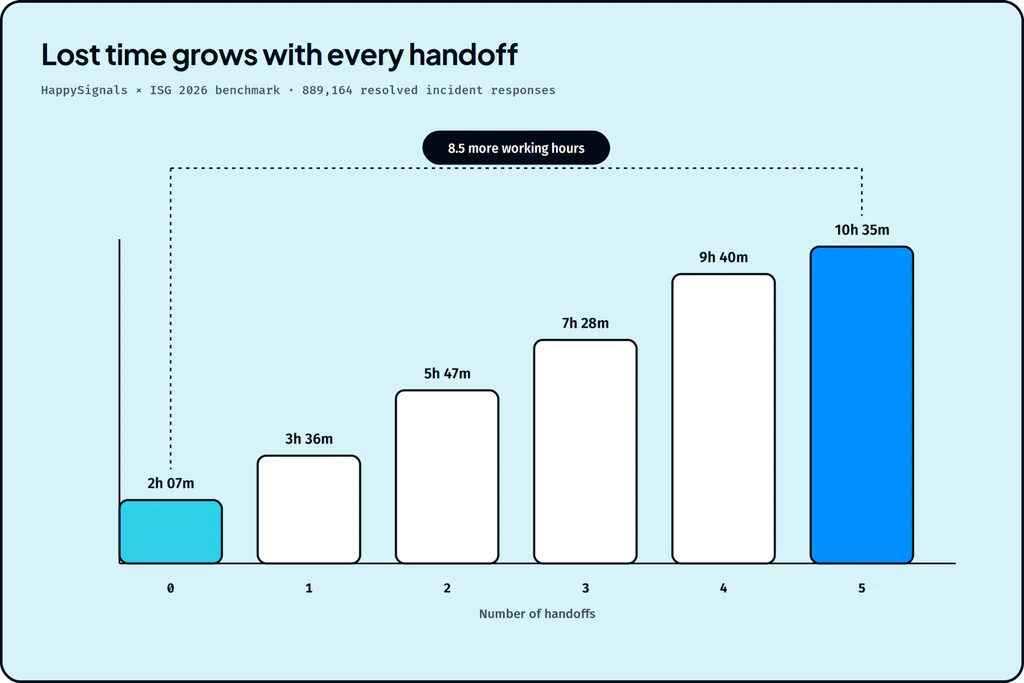
- Cross-system incidents are where contracts strain, since the HappySignals and ISG 2026 benchmark finds that a ticket handled by five teams costs the employee 8.5 more working hours than one resolved on first contact.
- AI agents with operational context can take repeat and routine tickets off the queue, so senior consultants spend their hours on cross-layer investigations and high priority decisions work.
What Do SAP Managed Services Cover?
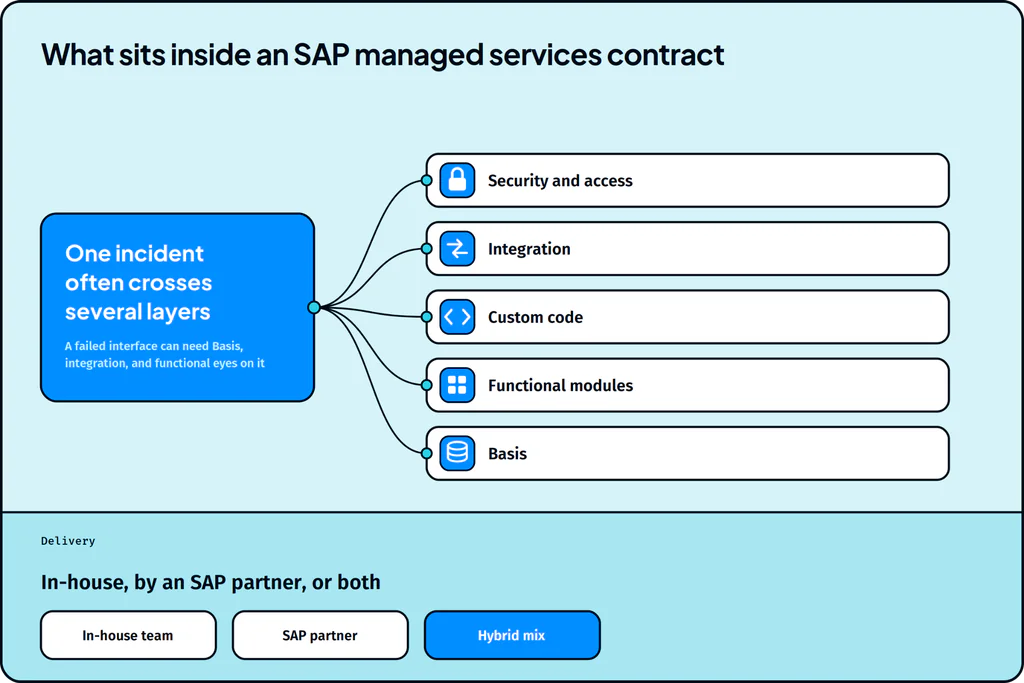
SAP managed services cover every layer of a live SAP landscape, and most contracts bundle all five layers under one SLA-tiered support structure. The work can be delivered in-house, by an SAP partner, or as a mix of both.
| Layer | What it covers |
| Basis | System health, background jobs, transports, SAP Notes, system copies |
| Functional modules | Configuration and process support across FI/CO, SD, MM, PP, HCM |
| Custom code | ABAP enhancements, custom reports, retrofits between landscapes |
| Integration | IDocs, middleware, links to Ariba, SuccessFactors, and non-SAP systems |
| Security and access | Roles, access requests, emergency access |
For a day-to-day view of each layer, including the tools and transaction codes specialists use, see Lightrun’s guide to SAP AMS. Most contracts also organize the work into tiered support from L0 to L3 plus a change cycle for transports and upgrades, which Lightrun covers in its guide to application management services.
In practice, the layers rarely stay separate. An incident that starts as a failed interface often needs Basis, integration, and functional eyes on it before anyone finds the cause, and that is where most managed services contracts show their limits.
SAP Managed Services vs. SAP AMS: Is There a Difference?
SAP AMS and SAP managed services are often used interchangeably, although AMS refers to ongoing support of the application layer while managed services usually covers the infrastructure and operations underneath it. Providers often sell both together, so the lines blur in contracts.
| SAP AMS (application management services) | Managed services (infrastructure and operations) | |
| Covers | Business applications, their configuration, custom code, and integrations | Servers, networks, cloud hosting, and IT operations |
| Typical work | Incidents, changes, enhancements, performance, Basis | Patching, backup, monitoring, capacity |
| Measured by | SLAs per priority, backlog, and availability of business processes | Uptime and response times |
- AMS is the narrower and more common term, and it describes support and maintenance of the application layer itself.
- Managed services is the broader umbrella that many providers sell, and it can add infrastructure and cloud operations, continuous improvement, and advisory work to AMS.
- For a buyer, the scope line in the statement of work determines what is covered, regardless of the label the provider uses.
How Is SAP Managed Services Priced?
SAP managed services pricing has long tracked effort, and Lightrun’s guide to application management services lists the common models as dedicated FTEs, time and materials, ticket-based pricing, a fixed pool of capacity hours, and outcome-based agreements tied to service levels or business results. The first four all scale with activity.
- Dedicated FTEs: a named team is reserved for your landscape, providing continuity and putting the cost on headcount.
- Time and materials: you pay for the hours worked, so a complex cross-layer incident costs more than a routine one.
- Ticket-based: each ticket is priced by type or priority, which is predictable for routine work and can undercharge long investigations.
- Fixed pool of capacity hours: simple to budget, and the risk of running over sits with whoever agreed the pool size.
- Outcome-based: fees are tied to service levels or business results, a model that rewards recovery over activity.
Most contracts also define P1 to P4 priorities with response and resolution targets, and these targets set what the provider commits to under whichever pricing model you choose.
How Does RISE with SAP Change the Pricing Conversation?
Under RISE with SAP, SAP’s Enterprise Cloud Services team runs the infrastructure, as described in Google Cloud’s RISE with SAP overview. Application-layer work such as interfaces, custom jobs, and incident handling stays with the customer or their AMS partner unless you buy SAP’s Packaged Services, formerly Cloud Application Services, for an additional fee. That split is a common budgeting surprise, so it is worth settling before signing, and Lightrun’s guide to SAP AMS walks through who runs what under RISE.
What Should You Look for When Evaluating an SAP Managed Services Provider?
Evaluating a provider means looking beyond the SLA sheet, and six checks predict whether an engagement buys speed or only paperwork.
- Scope clarity against RISE: the contract should state who owns interfaces, custom jobs, and application-level incidents.
- Cross-layer investigation capability: the provider should be able to trace an issue end to end instead of bouncing it between Basis, ABAP, and functional teams.
- Visibility beyond green dashboards: a job that shows “completed” without confirming that the business process finished is a known blind spot.
- Routine versus consultant-hours split: a provider that cannot tell you how much of the queue is routine is pricing without data.
- Governance on anything automated: look for approval gates, an audit trail, and read-only access by default for any AI layered into the service.
- Measurement beyond SLA: recovery confirmation, reassignment rate, and repeat-incident rate carry as much weight as response time.
How Are AI Agents Changing the SAP Managed Services Model?
Cross-system incidents are where the cost of handoffs becomes visible. The HappySignals and ISG 2026 benchmark, built on 889,164 resolved incident responses, reports how much working time employees lose as a ticket moves between teams:
- A ticket resolved on first contact costs employers about 2 hours and 7 minutes of specialist time.
- Each additional team adds time, and the first handoff alone adds 89 minutes.
- A ticket handled by five teams reaches 10 hours 35 minutes, which is 8.5 more working hours than a first-contact fix and works out to roughly 1 hour 42 minutes per additional team.
- Every handoff in a managed services contract, from Basis to ABAP to functional, adds time that either the provider bills or the business absorbs.
Lightrun brings a different delivery model into SAP managed services. Here AI agents carry the full operational context of the landscape and take on the routine share of the ticket queue. In practice, that changes what reaches a consultant:
- Tickets are triaged and classified by business impact as they arrive, rather than being worked in the order they were raised.
- Repeat, well-documented issues such as access requests, known errors, and standard requests are resolved within approved policy, with a human reviewing outcomes.
- Cross-system investigations that used to bounce between Basis, ABAP, and functional teams run as one investigation.
- Every automated action is gated by approval and logged for audit, so governance keeps pace with speed.
How Lightrun Fits Into an SAP Managed Services Engagement?
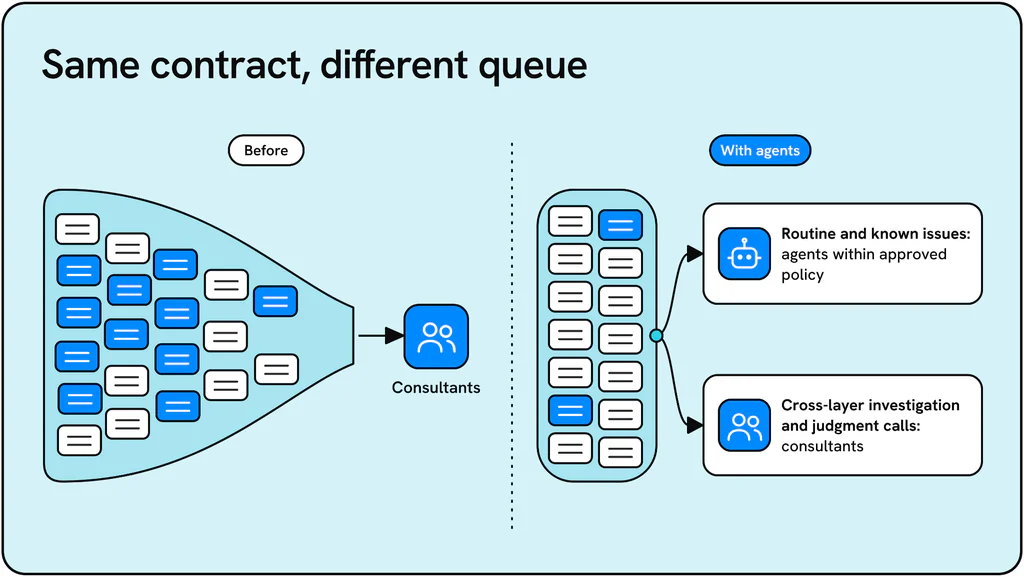
Lightrun works alongside an AMS provider or an in-house SAP team and adds customizable reliability agents that receive the operational context of each enterprise’s SAP landscape and connected systems. Routine tickets are resolved using approved policy while consultants focus on work that needs their attention.
- Incident Resolver: classifies tickets, traces failures to root cause across SAP and connected systems, and carries incidents through to an approved resolution.
- Change Risk Analyzer: analyzes transports and dependencies to produce a risk-scored change advisory board briefing before every change, which Lightrun explains in its piece on change advisory board agents.
- Permissions Manager: evaluates access requests against policy and live context, then routes least-privilege access for approval.
- Basis Operations Agent: monitors jobs, work processes, and capacity continuously and resolves failures before they escalate, within your governance policy.
Lightrun’s Forward Deployed Engineers customize these agents to each landscape, including legacy systems, legacy code, and non-API platforms. Agents are read-only by default; write actions need explicit approval, and permission settings, RBAC, and audit logs keep your team in control throughout.
What should you check before signing an SAP managed services contract?
| What to check | Why it helps |
| Scope against RISE responsibilities | Avoids paying twice or finding an uncovered gap in the middle of an incident |
| Cross-layer investigation process | Shows how many handoffs a real incident takes |
| Pricing model and SLA definition | Shows whether you are paying for speed or only for response time |
| Use of AI and automation, and its governance | Shows how much of the routine queue is offloaded, and how safely |
| Recovery and reassignment metrics tracked | Shows whether the provider measures outcomes or only tickets closed |
Why Is Recovery the Better Yardstick Than SLA Response Time
Most SAP managed services contracts are still priced and measured as if every ticket needs the same amount of senior time, even though a large share of a typical queue is routine. Response-time SLAs reward answering quickly, which says little about whether the business process recovered.
Providers and in-house teams keep pace by deliberately splitting that queue, with agents handling routine work within approved policy and consultants taking cross-layer investigations and judgment calls. Lightrun’s Reliability agents are built for that split, working alongside your AMS provider or in-house team with approval gates and audit logs on every action.
Judging an engagement on that basis, in addition to SLA tiers, shows whether the spend buys faster recovery or only more paperwork. A practical first step is to ask your provider for the routine versus consultant-hours split and the recovery and reassignment figures from the checklist above.
See how this split would work in your landscape
SAP managed services include ongoing support for five layers of a live landscape: Basis, functional modules, custom code, integration, and security and access. Most contracts bundle these under tiered support from L0 to L3, plus a change cycle for transports and upgrades.
AMS refers to support of the application layer, which covers configuration, custom code, integrations, and incidents, while managed services usually cover the infrastructure and operations underneath. Many providers sell both together, so the contract’s scope section determines what you receive.
Cost depends on the pricing model, which is commonly dedicated to FTEs, time and materials, ticket-based pricing, a fixed pool of capacity hours, or an outcome-based agreement, and on the size and complexity of the landscape. Request the routine versus consultant-hours split from any provider before comparing quotes, since it shows how much of the price depends on senior time.
Under RISE with SAP, SAP’s Enterprise Cloud Services team runs the infrastructure, while application-layer work such as interfaces, custom jobs, and incident handling stays with you or your AMS partner unless you buy SAP’s Packaged Services for an additional fee. Confirm in writing what your contract assumes RISE covers.
AI agents with operational context take on the routine share of the ticket queue by classifying incidents by business impact, resolving known issues within approved policy, and tracing cross-system failures in a single investigation. Consultants then spend their hours on judgment calls, and every automated action is approved and logged for audit.