RPA vs Agentic AI: An IT Leader’s Guide
Oct 11, 2026 / Updated: Oct 11, 2026

Critical operations in finance, HR and supply chain run on RPA bots, business rules and a growing number of AI tools, across landscapes that change with every migration, upgrade and new AI deployment. When one of those processes stops, orders stall, suppliers go unpaid and the close slips. For the IT leaders accountable for those operations, the choice between RPA and agentic process automation decides how reliably processes hold up through that change. The two solve different problems, and each has a clear place in the automation stack.
Key takeaways
- RPA follows predefined steps and suits stable, high-volume tasks; it breaks when a screen, field or rule changes.
- Agentic process automation (APA) uses AI agents that reason across systems, adapt to variation and act under human approval.
- Migrations, upgrades and new AI tools keep changing the landscape bots depend on, and that change is where APA adds the most.
- Many enterprises run both: bots for stable work, agents for variable work and the exceptions bots hand off.
- APA has two jobs: running variable work, and helping prevent and resolve the exceptions that interrupt critical processes.
- APA scales when agents run on operational context and work under clear controls: read-only by default, approvals, role-based access and audit logs.
What is agentic process automation, and how is it different from RPA?
Agentic process automation (APA) combines rules-based automation with AI agents to run business processes that include variation rules alone can’t handle. Here, APA means a specific way of working: rules and bots handle the predictable steps, and agents investigate the variable work and the exceptions, then recommend or take actions within the permissions you set.
In the RPA vs agentic AI debate, three terms often get mixed up. AI agents are the software components that reason and act. Agentic AI is the capability those agents provide. Agentic process automation is the use of agents, alongside rules and bots, to run business processes and handle the exceptions that interrupt them.
The operating difference shows in how each one handles an exception. RPA follows a script. Agentic process automation handles variation. An RPA bot can process an invoice when its fields match the expected pattern. If the invoice total differs from the purchase order, the bot stops and raises an alert. In an APA workflow, rules still handle the routine cases. An AI agent can investigate the mismatch by checking the purchase order, the goods receipt and the vendor record, then recommend a next step, such as routing a price change for approval.
The category is maturing quickly. In July 2026, Gartner published its first Hype Cycle for Agentic Automation, describing agentic automation as poised to become one of the most transformative trends in modern process automation. Adoption is following: McKinsey’s 2026 State of AI survey found that 40% of respondents at organizations with more than $1 billion in revenue report scaling AI agents, up from 27% a year earlier. For IT leaders, that makes the comparison with RPA a practical question: which processes stay with bots, and which need agents?
How do RPA, intelligent process automation and APA compare?
RPA, intelligent process automation (IPA) and agentic process automation are three approaches that can work together. Each one handles a different kind of work, and the difference shows most clearly when something unexpected happens.
RPA
Intelligent process automation
Agentic process automation
How it works
It follows predefined steps exactly as scripted.
It adds AI to RPA for documents and simple decisions.
It uses AI agents that reason and act across systems.
Handles variation
It handles variations covered by its rules.
It handles some variation, such as invoices in different layouts.
It handles variation by reading context across systems.
When a step breaks
It stops and raises an alert.
It routes the item to a person.
It investigates the cause and proposes a fix.
Human role
People fix and rerun failed runs.
People review the items it flags.
People approve the actions agents propose.
Best fit
It suits stable, high-volume tasks.
It suits document-heavy workflows.
It suits variable, cross-system processes and exceptions.
![Comparison of what happens when a process step breaks: RPA stops and raises an alert, intelligent process automation routes the item to a person, and agentic process automation investigates and proposes a fix for approval.]](https://lightrun.com/wp-content/uploads/2026/10/rpa-vs-agentic-ai-when-a-step-breaks-1-1024x462.png)
RPA runs stable, high-volume tasks reliably
RPA is at its best on work that looks the same every time: copying data between screens, pulling scheduled reports, posting standard documents. When the screens, fields and rules stay put, a bot is fast, cheap and predictable.
Intelligent process automation adds AI to documents and decisions
Intelligent process automation layers AI onto RPA, so bots can read invoices, classify emails and make simple, trained decisions. It widens what automation can take in, while the process itself still follows a fixed path.
APA handles variation and exceptions across systems
Agentic process automation takes on the work that falls outside a fixed path. Agents gather context from several systems, decide what’s happening and act within the permissions you set. That makes APA the right approach for processes that span SAP and non-SAP systems, and for the exceptions that the other two approaches hand back to people.
Upkeep differs too. A bot’s scripts need updating whenever a screen, field or rule changes, so maintenance grows with every release. Agents still need configuration, governance and testing, but because they read the current state of a process, they can absorb some routine changes that would break a script.
Why does RPA break when your landscape changes?
RPA depends on things staying the same, and enterprise landscapes rarely do. Every change to a screen, a field, a table or a rule is a chance for a bot to fail, and the pace of change is rising from two directions at once.
Migrations and upgrades change the screens and rules bots depend on
An S/4HANA migration, often part of a RISE with SAP move, or a routine support pack can change user interfaces, data structures and custom code in one go. Bots built against the old landscape keep running and can start failing in ways that are hard to trace, sometimes weeks after go-live. Each failure lands on the IT or application management services team as a ticket, while the process it supported waits. An agent with access to the right data handles this kind of change differently. When a field moves or a status code changes, it can read the current state of the transaction across systems, investigate what changed and recommend a fix for someone to check.
New AI systems add moving parts to every workflow
At the same time, AI agents are arriving in the systems that run critical processes. In KPMG’s Q3 2026 U.S. AI Pulse Survey, 62% of organizations said they are building, deploying or developing AI agents, up from 53% the quarter before, and 25% are now developing or implementing multi-agent systems, up from 6% (KPMG, September 2026). Alignment is lagging behind: in a Gartner survey of 360 IT application leaders, only 14% strongly agreed that IT, business users and leadership are aligned on what problems AI will solve (Gartner, September 2025).
Every new tool touches the same data, approvals and integrations your bots rely on. A useful test for your own landscape: how many of last quarter’s bot failures started with a change somewhere else?
Should APA replace RPA?
The RPA vs agentic AI question rarely ends with one replacing the other. Bots that run stable tasks reliably keep their place, and agents take on the work bots were never built for: variation, judgment and the exceptions that cross system boundaries.
A failed bot run is itself an exception. An agent can investigate why it failed, such as a renamed field after an upgrade or an interface that stopped sending a value, and propose a fix with the evidence.
In practice, most teams start in one of two places:
- Where bots fail most often. Processes that break after every change are the clearest signal that rules alone can’t keep up.
- Where exceptions pile up. Queues of blocked orders, stuck invoices or failed jobs show where people are doing the investigative work agents are built for.
Adding agents to those two places extends the automation you already have, so the investment in RPA keeps paying back.
What are the two jobs of APA?
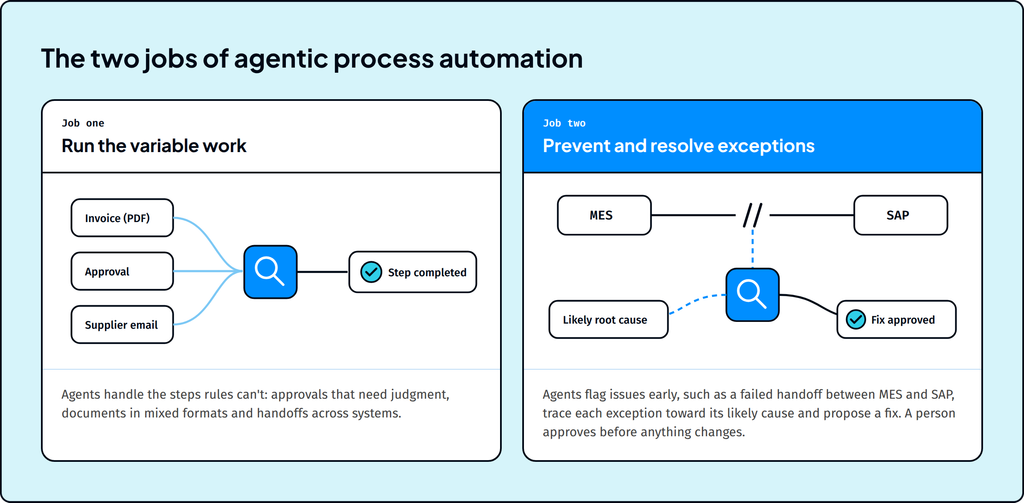
Agentic process automation has two jobs: running variable work, and keeping critical processes running when something breaks. Most descriptions focus on the first. For IT leaders accountable for critical operations, the second matters just as much.
Job one is running the variable steps rules can’t handle
This is the familiar side of APA. Agents handle approvals that need judgment, documents in mixed formats and handoffs that span several systems. Each of these steps would need dozens of brittle rules in a bot; an agent handles them by reading the context in front of it.
Job two is preventing and resolving the exceptions that stop a process
In an SAP-run enterprise, the exceptions are where processes actually stall. A few common examples:
- A production order confirmed in MES never posts back to SAP, so stock levels drift and deliveries slip.
- Vendor master data changes in one system and not another, and invoices start blocking for the same terms variance every week.
- A reconciliation job written for the old structure returns incomplete data after an upgrade, the night before the month-end close.
In SAP terms, exceptions like these sit inside every end-to-end process. In lead-to-cash (order-to-cash), sales orders stall on missing customer-material info records. In design-to-operate, stale IBP plan data breaks MRP and supply planning, and handoffs between SAP, MES and warehouse systems fail. In record-to-report and source-to-pay, GL posting mismatches and POs stuck between Ariba and SAP hold up the close. In recruit-to-retire (hire-to-retire), missing access or identity data stalls onboarding.
Configured with the right access, agents help prevent exceptions like these by flagging issues early, such as GL posting mismatches and failed jobs before close. For the exceptions that still surface, they investigate the likely source and propose a fix, and a person approves it before anything changes. Each cause that gets fixed removes a recurring source of exceptions. Our guide to AI agents in finance walks through where close and P2P exceptions start.
When an agent can’t confirm a cause. Agents won’t always find one clear answer. Take a blocked invoice where the vendor record, the PO and the goods receipt all look correct. A well-governed agent records what it checked, notes which causes it ruled out and escalates to the right owner with that evidence attached. The investigation still saves time, and a person makes the call.
How does operational context help agents fix root causes?
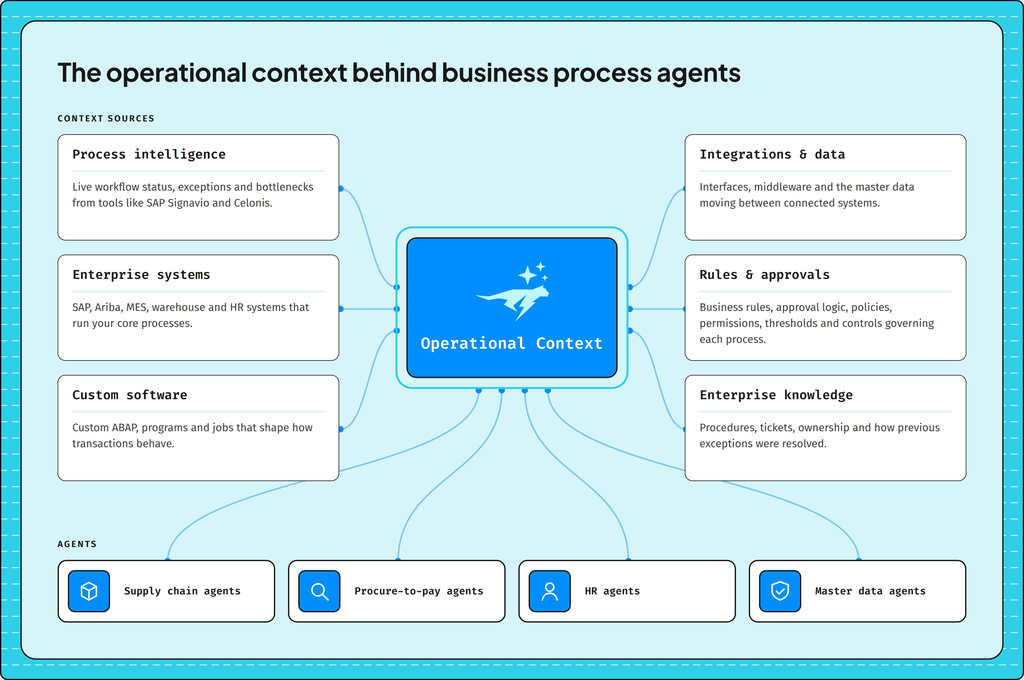
An agent can only fix a cause it can see. A production order that never posted to SAP might trace back to a custom ABAP routine, an interface that dropped a field, a changed approval rule or master data that drifted between systems. Seeing that full picture takes operational context: everything that shapes a transaction as it moves through your landscape.
Lightrun’s business process agents draw operational context from six sources:
- Process intelligence: live workflow status, exceptions and bottlenecks, including from SAP Signavio and Celonis
- Enterprise systems: SAP, Ariba, MES, warehouse and HR systems that run your core processes
- Custom software: custom code, programs and jobs that shape how transactions behave
- Integrations and data: interfaces, middleware and the master data moving between systems
- Rules and approvals: business rules, approval logic, policies, permissions, thresholds and controls
- Enterprise knowledge: procedures, tickets, ownership and how previous exceptions were resolved
With that context, an agent can trace an exception across systems toward where it started and give your team the likely cause, with evidence. That’s the model behind agentic process automation for SAP: customized agents that prevent and resolve the exceptions that stop critical processes, across SAP and connected systems.
How do you govern APA at enterprise scale?
Agents that touch critical processes need tighter controls than bots, because they decide as well as act. The same Gartner survey found only 15% of IT application leaders are considering, piloting or deploying fully autonomous AI agents, and only 13% strongly agreed they have the right governance structures in place to manage agents (Gartner, September 2025).
That points to agents working with people in the loop, and to five controls worth requiring from any APA platform:
- Read-only by default. Agents investigate and correlate data without changing anything.
- Explicit approval for every write action. Releasing a PO or correcting a record waits for an authorized person.
- Role-based access control. Agents see and act on only what their role allows.
- Full audit logs. Every step an agent takes is recorded, with timestamps.
- An evidence trail. Each proposed action comes with the data the agent used, so the approver can check its reasoning.
With those controls in place, approvers stay in charge of every change, and auditors can see who approved what and why.
How do you decide whether to extend RPA or add APA?
Before choosing between more bots and adding agents, these five questions show where each one fits in your landscape:
- Which bots fail most after a change? If the same processes break after every upgrade or migration, they need agents that read context.
- Do your critical processes cross SAP and non-SAP systems? Agents earn their place where one exception touches Ariba, SAP and a third system at once.
- Do you need exceptions resolved, or only routed? If your team spends its time investigating why things broke, look for agents that prevent and resolve exceptions at the source.
- What controls must govern write actions? Check for read-only defaults, approvals, role-based access and audit logs before any agent touches production.
- Can agents be customized for your landscape? Custom code and legacy systems are where many exceptions start. Lightrun’s Forward Deployed Engineers customize existing agents to your landscape, so you start from agents already built for SAP processes.
If most answers point to variation, cross-system processes and exceptions, that’s where agentic process automation adds the most.
How should you divide work between bots and agents?
RPA gives you speed and predictability on work that stays the same. Agentic process automation adds the ability to investigate what changes: the variable steps, the cross-system handoffs and the exceptions that interrupt critical processes.
The practical division of work is clear. Keep bots on predictable steps. Use agents where exceptions need investigating. Require evidence and human approval for any action that affects production.
For IT leaders responsible for finance, supply chain or HR operations, the deciding factor is operational context. Agents that can see the rules, custom code, integrations and data behind each process are the ones that find the likely cause of an exception and give your team evidence to act on, across SAP and the systems connected to it. That’s how Lightrun’s business process agents help prevent and resolve failures across every layer of your enterprise.
Keep your core processes running
with operational context
FAQs about RPA and agentic AI
RPA follows predefined steps and stops when a screen, field or rule changes. Agentic AI reasons about context, decides the next step and adapts to variation, working under human approval. RPA suits stable, high-volume tasks; agentic AI suits variable, cross-system work and the exceptions RPA hands off.
Agentic process automation (APA) combines AI agents with rules-based automation to run business processes too variable for rules alone. In enterprises, APA also helps prevent and resolve the exceptions that interrupt those processes, under human approval and audit controls.
For most enterprises, agentic process automation extends RPA rather than replacing it. Bots keep running stable, high-volume tasks, while agents handle variable work and investigate the exceptions bots hit, such as a failed run caused by a changed field or interface.
Agentic process automation works across SAP and connected systems such as Ariba, SAP Signavio and Celonis. Agents customized to your SAP landscape, including custom code, trace an exception across those systems to its likely cause and propose a fix for a person to approve.
Agentic process automation can be used in critical operations with controls such as read-only access by default, explicit approval for every write action and role-based access control. Full audit logs show what each agent did, what evidence it used and who approved each change.