Top Java Communities and Forums for Developers
Oct 30, 2020 / Updated: May 11, 2026

With roughly 9 million Java developers worldwide, knowing where to find the right community, whether you need a quick answer, a peer review, or a conference to sharpen your skills, saves real time. This guide covers the 16 best Java communities, forums, and groups, organized by use case so you can find what you need without sifting through dead forums or gated lists.
Key Takeaways
- Stack Overflow and CodeRanch are the go-to platforms for code Q&A; Reddit’s r/java and r/javahelp cover discussion and debugging help
- Discord has replaced Slack as the primary real-time Java community platform, the Java Discord server is the most active
- Java User Groups (JUGs) exist on almost every continent and are free to join; find yours at dev.java/community/jugs
Why Java Communities Still Matter
Java is the language that refuses to slow down. With Java 21 and Java 25 both carrying LTS status, the ecosystem is undergoing real change, virtual threads, pattern matching, and the continued growth of frameworks like Spring Boot, Quarkus, and Micronaut are keeping Java developers busy and, frankly, in need of good communities.
AI-assisted coding has raised the floor on what individual developers can ship. But it has also raised the ceiling on what can go wrong in production, unfamiliar code, subtle runtime behavior, and edge cases that no LLM anticipated. Communities are where you make sense of all of it: they surface tribal knowledge, fill documentation gaps, and connect you to engineers who have hit the same wall before.
Q&A Platforms: Get Unstuck Fast
These are the places to go when you have a specific problem and need an answer, not a discussion.
Stack Overflow: Java Tagged Questions
Stack Overflow remains the most comprehensive repository of Java problem-solving knowledge on the internet.
The Java tag here hosts over 1.9 million questions, making it the single largest collection of practical Java Q&A anywhere. Search before you post, the answer to most problems already exists.
When you do post, include a minimal reproducible example; questions without one are routinely downvoted regardless of how valid the underlying problem is.
Stack Overflow is the place for code-level questions: exceptions, API usage, debugging specific behavior. It is not the place for architecture discussions or career advice — use the communities below for that.
CodeRanch (formerly JavaRanch)
CodeRanch is one of the oldest and most welcoming Java forums on the internet, active since the late 1990s.
It has separate forums organized by experience level,
- Beginning Java,
- Java in General,
- and advanced topic forums covering frameworks, databases, and certifications.
The culture explicitly encourages beginners and discourages elitism, making it a reliable first stop for developers earlier in their Java journey. The signal-to-noise ratio is high because the community is moderated carefully.
Reddit Communities: Discussion and News
Reddit hosts three distinct Java communities, each serving a different purpose. Joining all three takes two minutes and gives you a well-rounded feed.
r/java: News and Ecosystem Discussion
r/java is for news, technical content, and ecosystem discussion, not code help.
Expect posts covering new Java releases, framework benchmarks, JEP discussions, and opinion pieces from senior engineers. The community is active and opinionated.
This is a good place to track what experienced Java developers are thinking about. Beginner questions are redirected and occasionally downvoted, so read the rules before posting.
r/javahelp: Code Questions and Debugging Help
r/javahelp is where you post code and ask for help with it.
Unlike r/java, this community exists specifically to answer questions, and it does so with patience. Post your stack trace, your minimal code snippet, and what you have already tried. The community responds well to engineers who show they have made an effort.
r/learnjava: Beginner-Focused Learning
r/learnjava is the right starting point for developers new to Java or returning after time away.
It has an extensive wiki of curated learning resources and a friendly culture that prioritizes clear explanations over technical one-upmanship. If you are working through a Java course or book and hit a concept that is not clicking, this is the subreddit to post in.
Discord Servers: Real-Time Help
Discord has overtaken Slack as the primary platform for real-time developer conversation. For Java, there are two servers worth joining.
Java Discord: Official Community Server
The Java Discord server is the most active Java-specific Discord community, with dedicated channels for beginners, intermediate, and advanced questions.
It covers core Java, Spring, JVM internals, and framework-specific help. Questions get responses quickly, particularly during peak hours. The server is moderated and maintains a code of conduct, which keeps the quality of interactions high.
The Programmer’s Hangout
The Programmer’s Hangout is one of the largest general programming Discord servers and includes an active #java channel.
It is useful when your problem spans languages or when you want a broader development perspective. The server also has channels for code review, career advice, and project collaboration, making it a strong community for developers who work across multiple languages.
Official Java Channels: Oracle and OpenJDK
These are authoritative sources — the primary channels where Java itself is discussed, decided, and documented.
dev.java: Oracle’s Official Java Developer Hub
dev.java is Oracle’s official home for Java developers, hosting documentation, tutorials, API references, and the Java Magazine.
It also aggregates content from the Java Champions and links to the official JUG directory. For anything related to the language specification, JDK releases, or official guidance on new features like virtual threads or records, start here.
OpenJDK Mailing Lists
The OpenJDK mailing lists are where JDK development actually happens.
If you want to follow JDK proposals (JEPs), discuss language changes with the engineers who write them, or contribute to the platform itself, this is where that conversation lives.
It is a high-signal, low-noise channel, not for general questions, but essential for engineers who want to understand Java’s direction.
Java Champions Program
The Java Champions are a group of recognized Java technologists and community leaders sponsored by Oracle.
They are active contributors to JUGs, conferences, and online content. Following Java Champions on LinkedIn, Twitter/X, or their personal blogs is one of the fastest ways to stay current on what actually matters in the ecosystem. The program does not require joining, their public output is the value.
Java User Groups: Local and Global
Java User Groups are volunteer-run developer communities found on almost every continent, and they are consistently among the most valuable resources in the Java ecosystem.
Most JUGs host free monthly meetups with technical talks, workshops, and Q&A sessions. Many also run annual regional conferences and maintain mailing lists or Slack channels for ongoing discussion.
JUGs are worth joining for three specific reasons: local networking with engineers who work on similar problems, direct access to Java Champions and conference speakers, and the ability to give talks yourself, a significant career lever that is easier to pursue at a JUG than at a major conference.
To find a JUG near you, the official directory is at dev.java/community/jugs. Notable active JUGs include:
- London Java Community (LJC) — one of the largest JUGs in Europe, with frequent events and strong ties to the Java Champions community
- NY Java SIG — active in the New York metro area
- JUG Switzerland — hosts events across Basel, Bern, Zurich, and Lucerne
- Bangalore JUG — co-organizes the large annual Java conference in India with other regional JUG chapters
Conferences Worth Following
In-person conferences are where the Java ecosystem sets its direction: new framework releases, JDK previews, and production war stories that do not make it into blog posts.
Devoxx is a series of global, community-driven Java and JVM conferences.
Originally Belgian, Devoxx now runs events across the US, UK, France, Morocco, Poland, and Ukraine. Sessions are recorded and posted publicly, making Devoxx one of the best free sources of expert Java content available.
DevNexus is the longest-running and largest Java ecosystem conference in the US, running annually in Atlanta.
With 14 tracks and over 160 expert speakers, it covers the full Java stack from language features to distributed systems.
JavaOne is Oracle’s flagship Java developer conference, running since 1996.
JavaOne 2025 celebrated Java’s 30th anniversary alongside the Java 24 launch, a good signal that Oracle is investing in the community side of the ecosystem.
JavaZone is one of Europe’s largest Java conferences, organized by the Norwegian Java User Group javaBin.
The 2025 edition brought together over 3,000 developers, architects, and engineers. Session recordings are posted publicly.
JFokus runs annually in Stockholm and is the largest developer conference in Scandinavia, covering Java, JVM languages, and modern software architecture.
Blogs, Newsletters, and Content Hubs
Beyond forums and live communities, the following sources produce high-quality, ongoing Java content.
Baeldung is the most comprehensive Java tutorial site on the internet. It covers everything from core language features to Spring, security, and testing, with practical code examples and regular updates for new Java releases.
InfoQ Java covers Java news, architecture discussions, and deep technical articles from practitioners. Strong on frameworks, microservices, and JDK news.
Java Magazine is Oracle’s official publication for Java developers. Published bi-monthly with content from Java Champions and Oracle engineers.
dev.to Java tag surfaces community-written posts covering tutorials, opinions, and tooling. Quality varies, but there is a large volume of practical content and active comment threads.
LinkedIn and Professional Groups
There are two LinkedIn groups that are still worth following for professional Java networking.
Java Developers is the largest Java-specific LinkedIn group, with regular posts from framework authors, conference organizers, and Java Champions. It is worth following for job opportunities and industry news, though active technical discussion happens more reliably on the platforms above.
Spring Framework Users is a focused group for Spring Boot and Spring Framework developers. More signal than the general Java group for engineers working in that ecosystem.
Slack Communities with Java Channels
Most dedicated Java Slack workspaces have migrated to Discord. However, DevChat Slack remains active with over 19,000 members and a dedicated #java channel alongside channels for Python, JavaScript, and general web development.
It is a generalist developer community, useful if you work across multiple languages and want one Slack workspace rather than multiple Discord servers.
When Communities Aren’t Enough: Debugging Java in Production
Communities are where you learn Java. They are not where you debug it at 2am when a NullPointerException surfaces in production code that has been running fine for six months, with no logs, no reproduction steps, and a growing SLA breach.
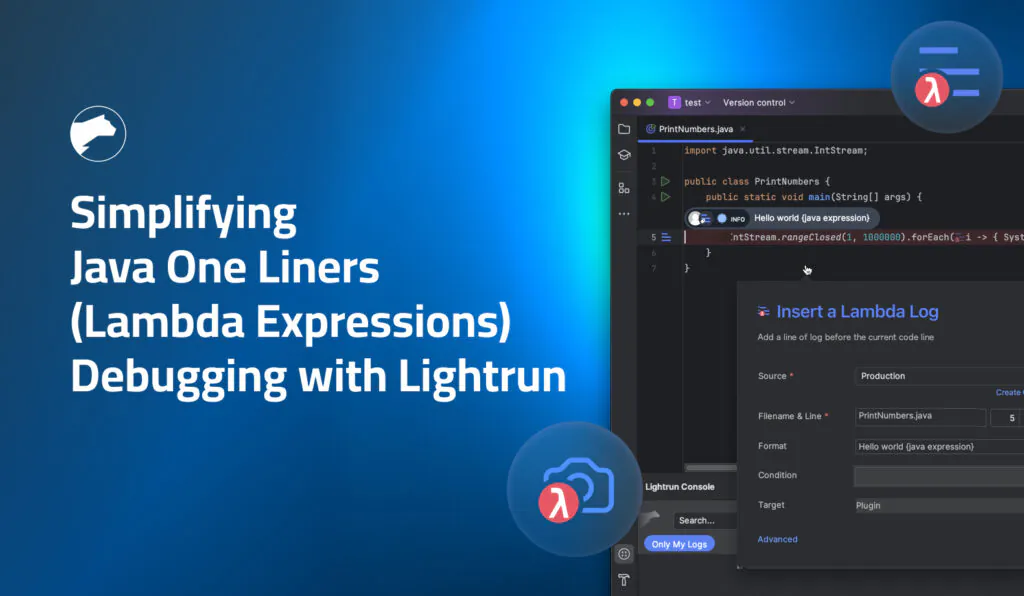
Lightrun’s Runtime Context lets engineers add dynamic logs, snapshots, and metrics to a running JVM without redeployment or service interruption.
When a ClassCastException appears in a multithreaded payment processor, you can capture the exact object state at the failure line in the live service, without changing a single line of code or taking a maintenance window.
The evidence is generated on demand, at the exact point in the execution path where something went wrong.
Communities answer the question “how does Java work?” Lightrun’s runtime sensor answers “what is my Java doing right now, in production, on this specific request?” Both matter. They solve different problems.