

Runtime Context: The practical definition for the AI Era
TLDR: Runtime Context is live, execution-level access to a running production system. It lets engineers and AI agents ask precise questions of running code and get answers immediately, without redeploying or interrupting users. This is the new baseline for reliability.
The verification gap
AI coding assistants have radically sped up software creation.
But engineering teams have hit a new bottleneck: validating that this code actually behaves correctly in production, and fixing it fast when it does not. That validation is still constrained by tools designed over a decade ago.
Today engineers and AI assistants rely on just-in-case telemetry. Static logs and traces injected before deployment, based on assumptions made months earlier. The logs once shipped define the investigation that you are allowed to run.
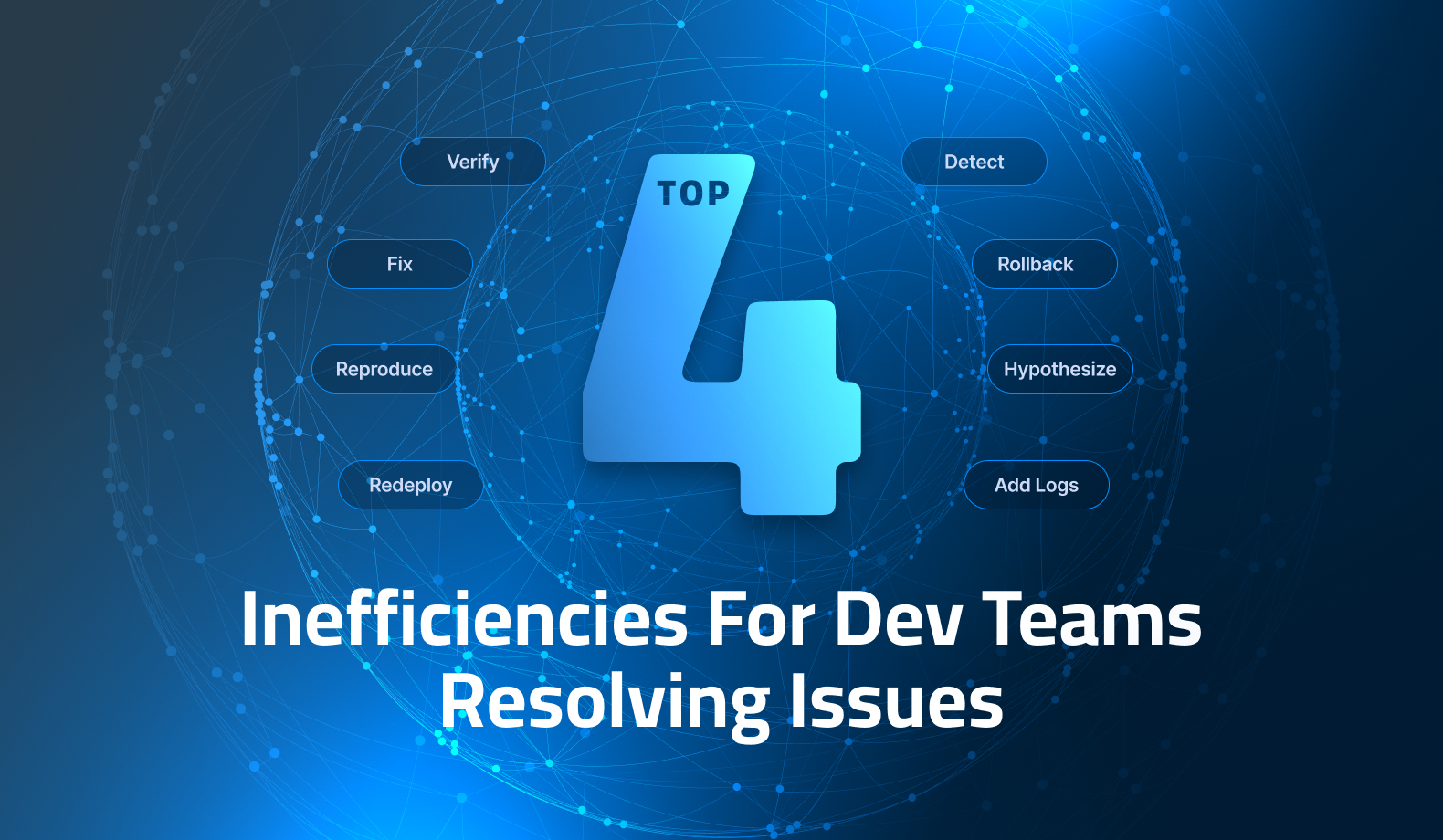
When an incident occurs, teams enter a familiar loop.
Roll back. Add logs. Redeploy. Wait.
By the third redeploy, the issue still has not reproduced, and the data you needed was never captured. The system is live, but you are blind to what matters. Most teams only realize this after they’ve already redeployed twice.
To operate at AI speed, engineers need the ability to change what they observe while systems are running.
That is why Lightrun created Runtime Context.
What is Runtime Context?
Runtime Context is the live, execution-level evidence of how systems behave in production. Put simply, it is the ability to reach into a running application and ask:
“What is happening right now, at this exact line of code, for this specific request, for this specific user?”
It is live interrogation without code changes, restarts, or disrupting users.
Runtime Context is enabled by three mechanisms:
- Dynamic telemetry: Injecting logs and metrics into running code on demand.
- Non-breaking breakpoints: Snapshotting stack traces and variables without rollbacks.
- Sandboxed environment: Investigating production logic and responsiveness safely without breaking user flows.
AI assistants can access this context through MCP, allowing copilots in the IDE to run evidence-based validation and troubleshooting across staging and production environments.
If you are not interrogating the runtime, you are just reading your system’s history.
Here is why it is no longer enough to work without this context.
1. Runtime Context is not post-hoc
Legacy telemetry is post-hoc by design.
Its fatal flaw is pre-aggregation. Engineers must decide at write time which dimensions might matter later. To control costs, high-cardinality data like user IDs, session IDs, or request IDs is dropped.
Visibility becomes a probability game, with blind spots created exactly where you need to investigate.
If your team did not predict that, for example, “User_ID” combined with “Region_East” could trigger a failure, dashboards will show “All Green,” while real users experience outages.
The legacy model limits you to the questions you knew to ask in advance.
Runtime Context removes that constraint. It allows any question to be asked live, on running systems. There are no redeployments to get answers, and no waits.
2. Runtime Context ends the ‘Push model’
Traditional observability relies on a Push model. It requires teams to ship massive volumes of logs and spans into storage, just in case.
This leads teams right into the high-cardinality trap.
As soon as engineering departments try to track granular data, like unique “Session IDs” or AI-generated “Request IDs”, index sizes explode. Vendor bills follow.
Gartner 2025 research showed the scale of the financial impact:
- 50% of observability budgets are spent on logs,
- 36% of enterprises spend over $1M/year
- 4% of enterprises spend over $10M/year.
Teams pay enormous sums to store debug data that neither humans nor AI ever read. At the same time, they are forced to sample or ignore most traffic to control costs.
Instead of collecting everything just in case, engineers request and pull in exactly the logs and snapshots they need, at the moment they need them. These logs vanish once their function is complete. Data collection is precise, temporary, and costs virtually nothing when idle.
3. Runtime Context is proof, not inference
Legacy observability offers symptoms, not provable causes.
Relying on legacy sources, dashboards give fragments of disconnected signals: a CPU spike, a latency jump, or an error rate increase. From these, engineers, APM tools, and AI agents are forced to build inferences, and correlate timestamps to create cause-and-effect theories.
But in distributed systems, correlation is rarely causation.
A database lock in one service can look like a memory leak in another. Teams waste hours proving which components are not responsible. Mean Time to Innocence becomes a major tax.
Runtime Context replaces inference with proof.
By capturing live application state, engineers work from direct evidence, not theories. This shift is essential for AI systems. Agents cannot guess safely. They must interrogate the runtime to validate root causes with certainty.
The new baseline
In a world of AI-accelerated velocity, inference is a liability.
Legacy telemetry was built for a world where we had hours to debug each incident. In 2026, we are working at the AI speed.
Runtime Context provides live evidence on demand. It allows teams to verify behavior, identify causes, and prove safe resolutions quickly. It also gives AI agents the ability to validate their own work before it causes harm.
It turns software reliability from a game of probability into a discipline grounded in evidence.
It’s Really not that Complicated.
You can actually understand what’s going on inside your live applications.